
Industrial Agitator Manufacturer
SV Industries manufactures industrial agitators for reactors, tanks and process vessels, with configurations developed around the required mixing duty, product properties, vessel geometry and operating conditions.
Depending on the application and confirmed project requirements, an agitator system can be configured with different impeller families, single- or multi-stage arrangements, drive and shaft configurations, sealing options and integration with new or existing process vessels.
What is an Agitator?
An industrial agitator is a mechanical mixing system used to create circulation, blending, suspension or other required fluid motion inside tanks, reactors and process vessels. The agitator configuration is selected according to the process duty, product properties, vessel geometry and operating conditions.
Hydrofoil impeller trial at SV Industries
What Is an Agitator Used For?
Depending on the application, agitators may be used for liquid blending, solids suspension, powder incorporation, heat-transfer support, maintaining uniformity, and other mixing duties. The required impeller type, speed, number of stages and drive arrangement depend on the process requirement.
How Does an Industrial Agitator Work?
An industrial agitator transfers mechanical power from the drive through the shaft to the impeller. As the impeller rotates, it produces fluid motion and circulation suited to the required mixing duty. The resulting flow pattern depends on the impeller geometry, operating speed, vessel geometry and process conditions.
Step-by-Step Working of an Industrial Agitator
01 — Drive Rotation
The motor and gearbox provide the required rotational speed and torque to the agitator shaft.
02 — Shaft Transmits Power
The shaft transfers the drive torque to one or more impellers positioned inside the vessel.
03 — Impeller Generates Flow
The rotating impeller creates axial, radial or mixed flow depending on its geometry and operating conditions.
04 — Process Mixing Takes Place
The generated circulation is used for duties such as blending, solids suspension, heat-transfer support or other application-specific mixing requirements.
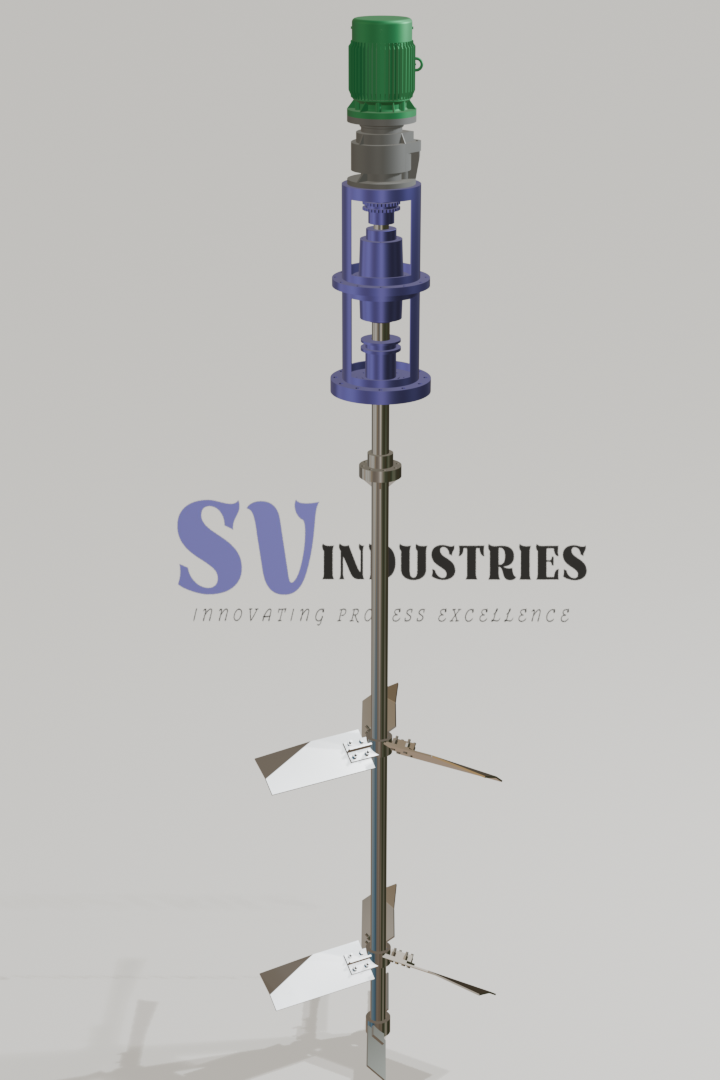
Impeller Types for Industrial Agitators
Different mixing duties require different impeller geometries and flow characteristics. SV Industries can configure agitator systems with suitable impeller families based on the process requirement, product properties, vessel geometry and operating conditions.
01
Anchor Impeller
A close-clearance impeller configuration commonly considered where higher-viscosity products and vessel-wall circulation are important.
02
Paddle Impeller
A straightforward impeller family used in applications where relatively simple circulation and mixing duties are required.
03
Rushton Turbine
A radial-flow turbine configuration used where strong local mixing and gas–liquid dispersion duties may be required.
04
Hydrofoil Impeller
An axial-flow impeller family developed to provide strong bulk circulation with an efficient flow-oriented blade geometry.
05
Pitched Blade Turbine
A versatile pitched-blade turbine configuration capable of producing axial or mixed-flow circulation depending on blade geometry and orientation.
06
Concave Disc Impeller
A disc-turbine configuration with concave blade geometry used for selected gas-dispersion and gas–liquid contacting duties.
07
Helical Ribbon Impeller
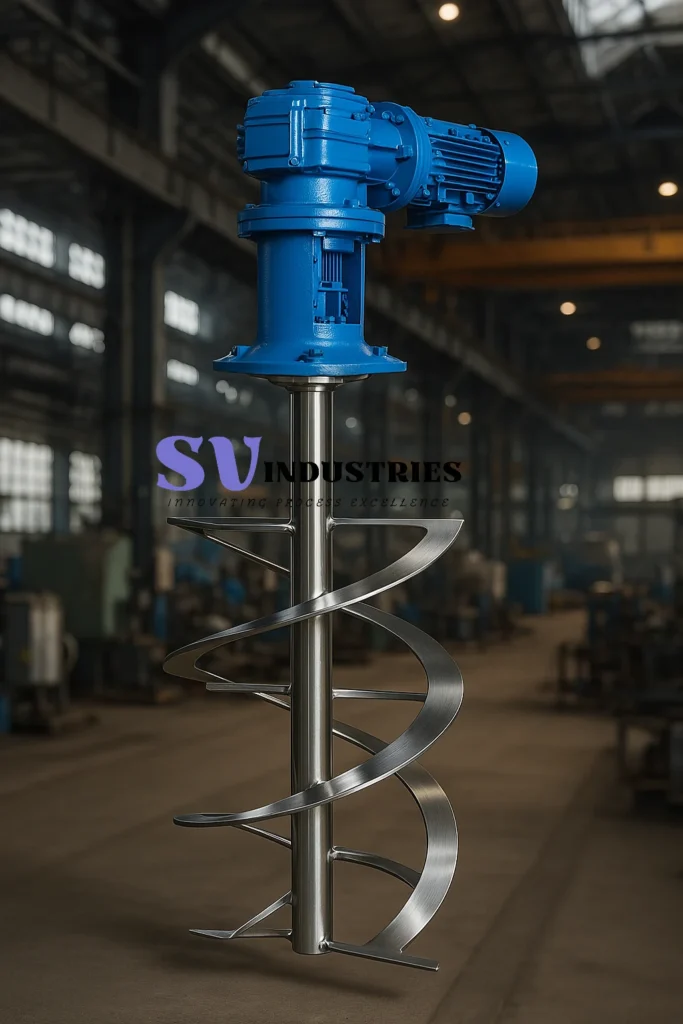
A close-clearance helical configuration used for mixing duties involving highly viscous products and strong vessel-wide circulation requirements.
How an Agitator Configuration Is Selected
Define the Mixing Duty
Blending, solids suspension, gas dispersion, heat-transfer support or another process requirement.
Review Product Properties
Consider the relevant viscosity, density, solids content, gas involvement and other operating characteristics.
Review Vessel & Operating Conditions
Tank geometry, liquid level, available mounting arrangement and process constraints affect the agitator configuration.
Select Impeller, Stages & Drive
The final system may use a suitable impeller family, one or more stages, and an appropriate drive, shaft and sealing arrangement.
Need Help with Agitator Selection?
Agitator Design & Construction Options
SV Industries configures industrial agitators around the process requirement, vessel arrangement and operating conditions. Depending on the confirmed project scope, the agitator assembly may include different drive, shaft, sealing, material and mounting arrangements.
Drive & Mounting Arrangements
Agitator assemblies can be configured with suitable motor and gearbox arrangements, with mounting selected according to the vessel, operating duty and available installation space.
Shaft & Stage Configuration
Shaft length, support arrangement and the number of impeller stages are selected according to vessel geometry, operating level, impeller configuration and transmitted torque.
Sealing Arrangements
The shaft sealing arrangement is selected according to the vessel service, pressure condition, process fluid and project requirements. Suitable sealing arrangements can be considered where applicable.
Materials & Surface Finish
Agitator wetted parts can be specified in suitable materials according to the process requirement. Surface finish and treatment requirements can also be defined as part of the project specification.
Integration with Tanks & Reactors
Agitators can be engineered for integration with new or existing tanks, reactor vessels, jacketed vessels and other process equipment, subject to the available vessel details and project design basis.
Industrial Agitator Technical Specifications
Industrial agitator specifications are developed around the required mixing duty, product properties, vessel geometry and operating conditions. Motor, gearbox, shaft, impeller, mounting and sealing arrangements are therefore selected on a project-specific basis.
| Specification | Configuration / Options | Selection Basis |
|---|---|---|
| Drive Arrangement | Motor with suitable gearbox or specified drive arrangement | Required speed, torque and process duty |
| Impeller Configuration | Paddle, Anchor, Rushton Turbine, Hydrofoil, Pitched Blade Turbine, Concave Disc and Helical Ribbon | Mixing duty and process characteristics |
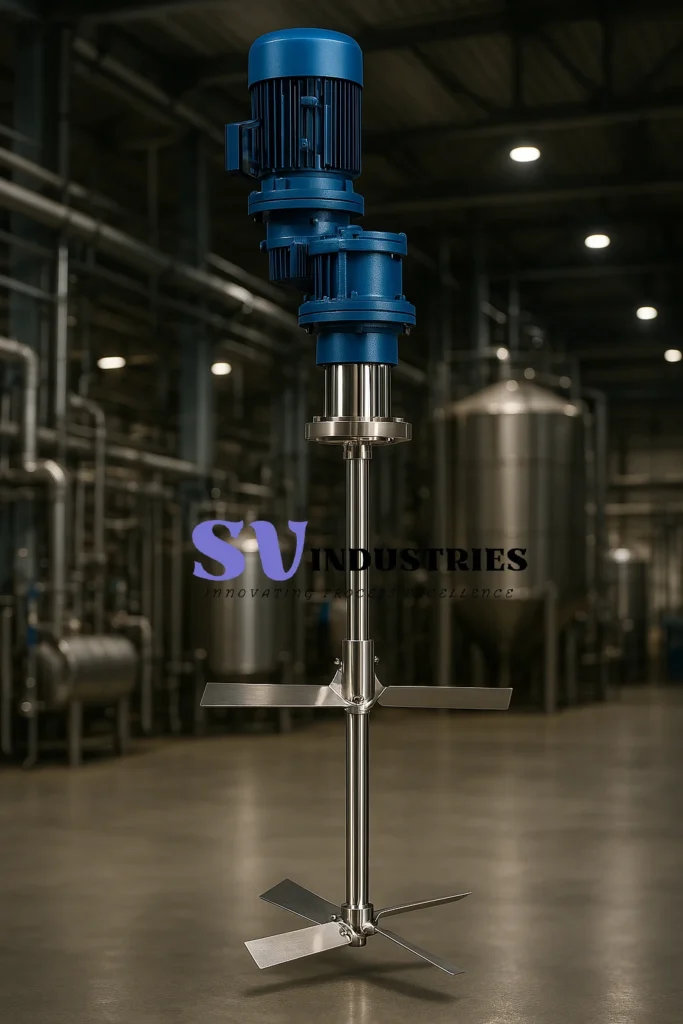
| Number of Stages | Single-stage or multi-stage configurations | Liquid level, vessel geometry and process coverage |
| Mounting Arrangement | Selected according to vessel and project configuration | Vessel layout and installation requirements |
| Shaft Configuration | Shaft length, diameter and support arrangement engineered to suit the application | Torque, vessel geometry, operating level and impeller arrangement |
| Materials of Construction | Suitable material selected for wetted and non-wetted components | Process fluid, corrosion requirement and project specification |
| Sealing Arrangement | Suitable shaft sealing arrangement where required | Vessel service, pressure condition and process fluid |
| Impeller Diameter | Engineered to suit vessel geometry and required mixing duty | Tank diameter, impeller family and process requirement |
| Operating Speed | Selected as part of the agitator design | Impeller type, process duty and required flow / shear characteristics |
| Vessel Integration | New or existing tanks, reactors and process vessels | Available vessel details and project design basis |
Note: Final agitator specifications are confirmed after review of the process requirement, vessel details and applicable project documentation.
Need a Project-Specific Agitator Specification?
Share your process requirements, vessel details and any available datasheet or drawing for engineering review.
Agitator vs Mixer: What’s the Difference?
In industrial processing, the terms agitator and mixer are often used interchangeably, but their meaning can depend on the equipment configuration and application. “Mixer” is a broad term for equipment used to combine, circulate or disperse materials, while “agitator” commonly refers to a shaft-driven mixing assembly installed in a tank, reactor or process vessel.
The correct equipment should therefore be selected from the required process duty, product properties, vessel geometry and operating conditions rather than from the equipment name alone.
| Aspect | Industrial Agitator | Mixer — Broader Term |
|---|---|---|
| Typical Meaning | Commonly a shaft-driven assembly mounted on or integrated with a tank, reactor or process vessel. | A broad term covering different equipment used for mixing, blending, dispersion or circulation. |
| Process Duties | Can be configured for blending, solids suspension, gas dispersion, heat-transfer support and other vessel-mixing duties. | Depends on the mixer type and may include many of the same duties. |
| Flow & Shear | May provide axial, radial or mixed flow with low, moderate or high shear depending on the impeller and operating conditions. | Depends entirely on mixer technology and operating conditions. |
| Configuration | Typically includes motor or drive, shaft and one or more impellers. | May include agitators, high-shear mixers, static mixers and other mixing technologies. |
| Selection Basis | Process duty, fluid properties, vessel geometry, operating level and required flow or shear. | The same process requirements determine the appropriate mixer technology. |
Is an Agitator the Same as a Mixer?
The terms overlap, but they are not always used in exactly the same way. An industrial agitator is commonly one type of mixing system used inside a vessel, while “mixer” can describe a much broader range of mixing equipment. For process selection, the required mixing duty and operating conditions are more important than the terminology.
Industrial Applications for Agitator Systems
Industrial agitators can be configured for a wide range of process duties across chemical, pharmaceutical, food, cosmetic, water-treatment and other manufacturing applications. Final agitator selection depends on the product properties, vessel geometry, operating conditions and required mixing duty.
Chemical Processing
Agitators may be configured for blending, solids suspension, reaction support and other mixing duties in chemical tanks, reactors and process vessels. Material, impeller and sealing arrangements are selected according to the process fluid and operating conditions.
Pharmaceutical Processing
Agitator systems can be developed for pharmaceutical mixing duties where controlled product handling, suitable material selection and project-specific surface-finish or sealing requirements are important.
Paints & Coatings
Mixing requirements in paints and coatings may include pigment incorporation, solids suspension, blending and maintaining product uniformity. The impeller configuration is selected according to viscosity, solids loading and the required mixing action.
Water & Wastewater Treatment
Agitators may be used for blending, chemical preparation, suspension and other tank-mixing duties in water and wastewater treatment systems, with configuration selected according to the process requirement.
Cosmetics & Personal Care
Agitator systems can be configured for creams, lotions, gels and other personal-care products, with impeller and operating conditions selected according to viscosity, shear sensitivity and required product movement.
Food & Beverage Processing
Agitators may be used for liquid blending, ingredient incorporation and other vessel-mixing duties in food and beverage processing, subject to the required material, finish and hygienic project specifications.
Paper & Pulp Processing
Agitators may be used for pulp stock preparation, fiber suspension, blending and other vessel-mixing duties in paper and pulp processing. Impeller configuration, operating speed and stage arrangement are selected according to slurry properties, vessel geometry and required circulation.
Polymers, Resins & Adhesives
Agitator systems may be used for blending, reaction support and maintaining uniformity in polymer, resin and adhesive processing. Configuration is selected according to viscosity, temperature, vessel geometry and required circulation or shear characteristics.
Fertilizer & Agrochemical Processing
Agitators may be used for liquid blending, solids suspension, slurry preparation and chemical-addition duties in fertilizer and agrochemical processing. Impeller type, operating conditions and materials are selected according to the process requirements.
Why Work with SV Industries for Industrial Agitators?
SV Industries develops industrial agitator systems around the actual process requirement, vessel configuration and project conditions. The focus is on practical equipment integration, suitable agitator configuration and clear engineering coordination from enquiry through fabrication.
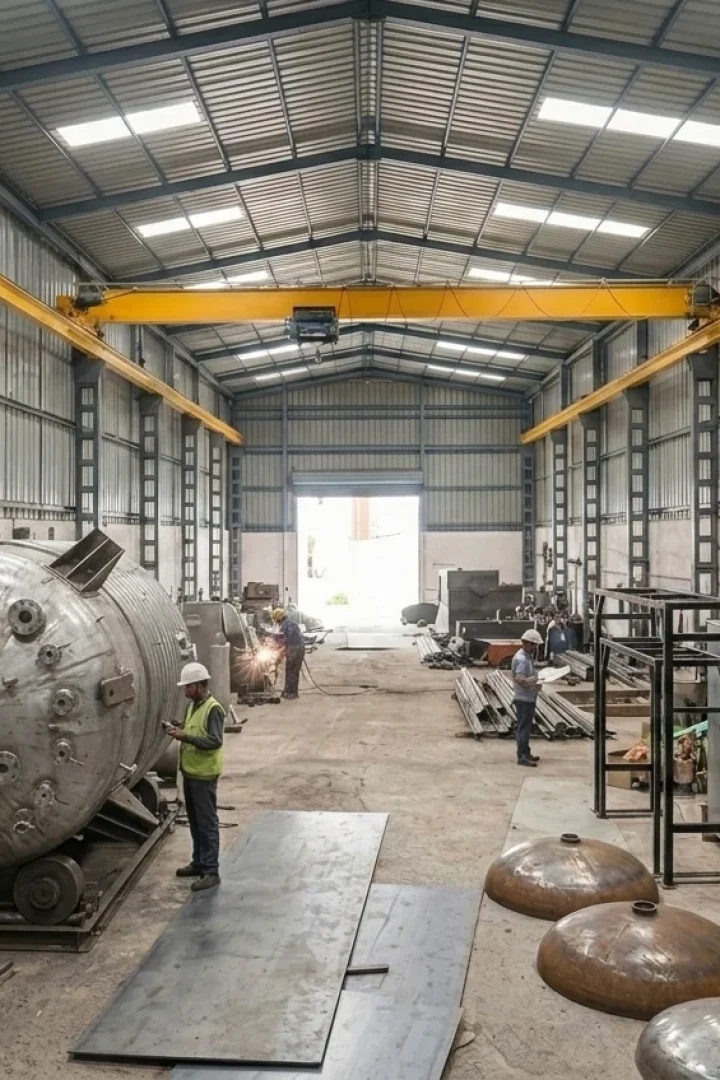
01 — Application-Specific Configuration
Agitator selection is developed from the required mixing duty, product properties, vessel geometry and operating conditions rather than from a fixed standard configuration.
02 — Agitator & Vessel Integration
Shaft length, impeller arrangement, mounting and sealing requirements can be coordinated with new or existing tanks, reactors and process vessels using the available project information.
03 — Multiple Impeller & Stage Options
Depending on the application, the agitator system may use different impeller families and single- or multi-stage arrangements to suit the required process coverage.
04 — Engineering Review Before Finalization
Final agitator specifications can be reviewed against the available datasheet, vessel drawing and process requirements before the project configuration is confirmed.
Industrial Agitator Configuration Gallery
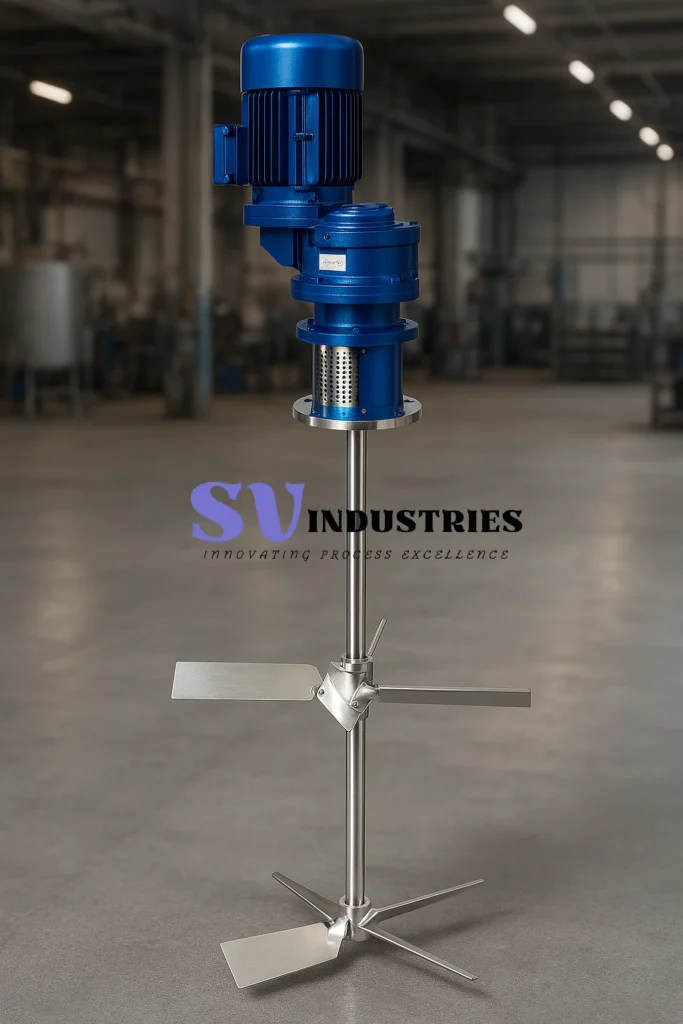
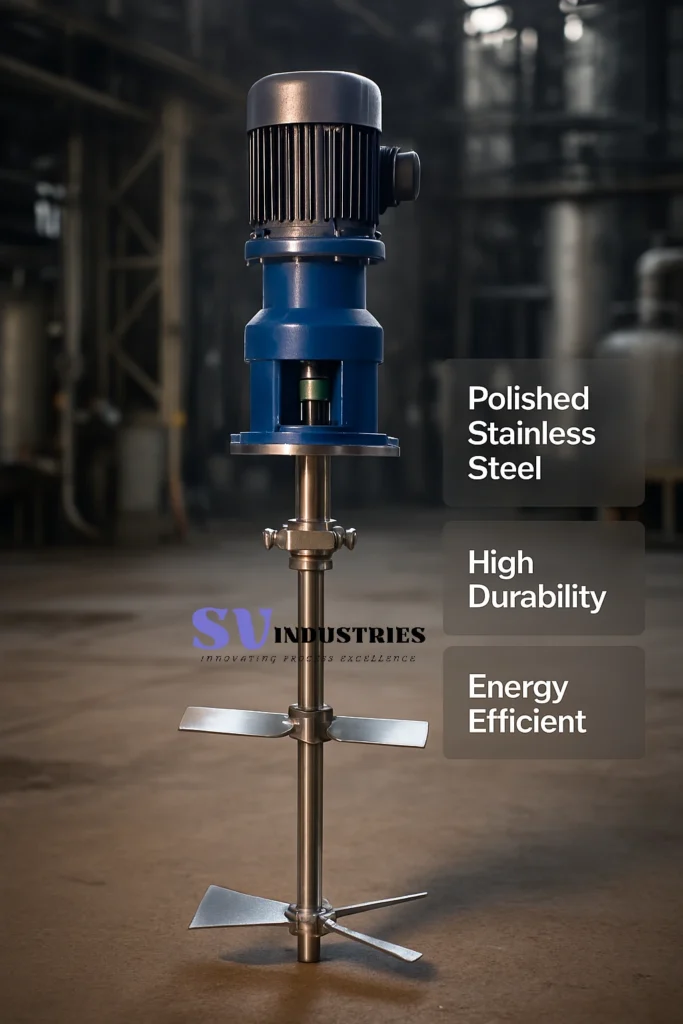
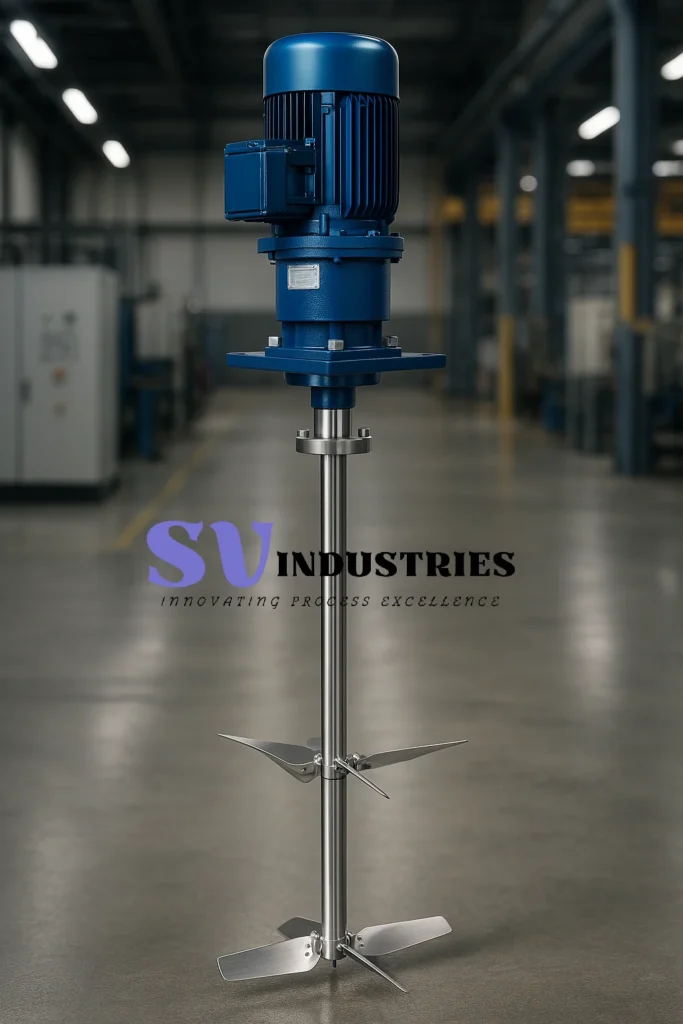
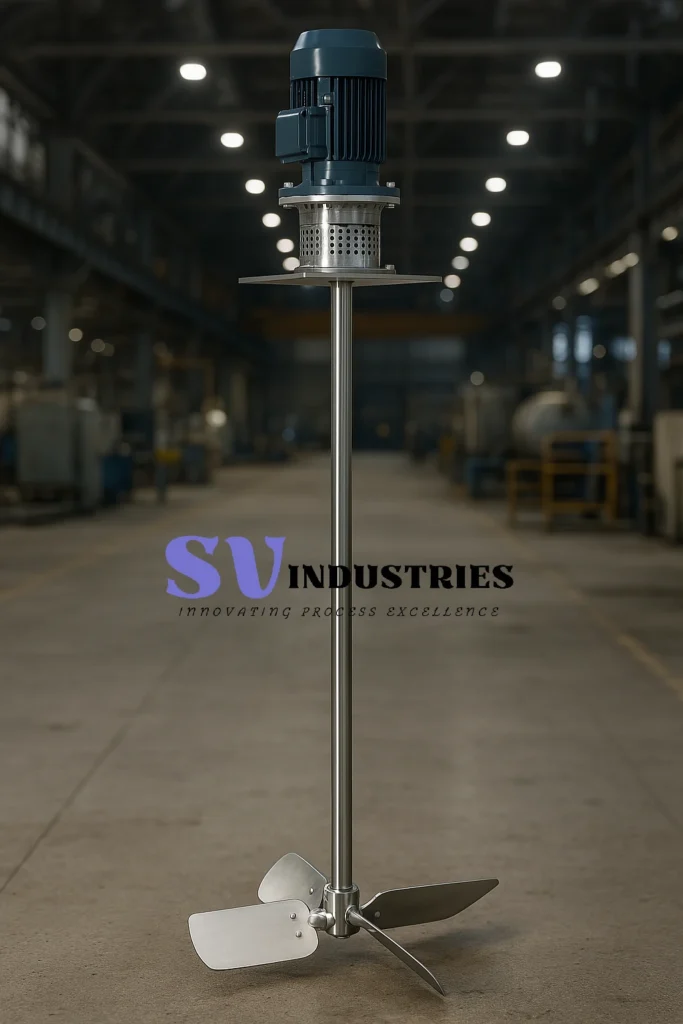
SV Industries develops agitator configurations around the required mixing duty, vessel geometry and operating conditions. The examples below illustrate different drive, shaft, impeller and stage arrangements that may be considered depending on the project requirement.
Final configuration is confirmed after review of the process data, vessel details and applicable project specifications.
Key Performance Factors in Industrial Agitator Design
Agitator performance depends not only on the selected impeller but also on how fluid circulation, shear, vessel internals and operating conditions interact within the process vessel. These factors are considered together when evaluating the required mixing behaviour.
Bulk Circulation
The agitator must generate sufficient movement throughout the required process volume. Circulation behaviour depends on the impeller geometry, operating speed, vessel proportions and liquid level.
Shear Environment
Different processes require different levels of shear. Impeller geometry and operating conditions are therefore selected with consideration for product sensitivity, dispersion requirements and the required mixing action.
Baffling & Vessel Internals
Baffles, coils, draft tubes and other vessel internals can influence circulation and flow behaviour. Their presence should be considered when developing the agitator arrangement.
Process Uniformity & Coverage
The agitator configuration should provide appropriate mixing coverage for the required duty, whether the objective is blending, solids suspension, gas dispersion, heat-transfer support or another process requirement.
Frequently Asked Questions (FAQs) About Agitators
What is the best agitator for viscous fluids?
Suitable agitator selection for viscous fluids depends on viscosity and rheology, vessel geometry, operating conditions and the required mixing duty. Close-clearance impellers such as Anchor and Helical Ribbon designs are commonly considered for viscous and laminar mixing applications, while paddle configurations may be suitable for certain intermediate-viscosity duties. Final selection should be based on the actual process requirements.
What are the types of impellers used in agitators?
Industrial agitators can use different impeller families depending on the required flow pattern and process duty. Common configurations include Anchor Impellers, Paddle Impellers, Rushton Turbines, Hydrofoil Impellers, Pitched Blade Turbines, Concave Disc Impellers and Helical Ribbon Impellers. The final impeller type is selected according to product properties, vessel geometry and operating conditions.
Can agitators be used for corrosive chemicals?
Yes. Industrial agitators can be configured for corrosive chemical service when suitable wetted materials and sealing arrangements are selected for the process fluid and operating conditions. Material selection should consider the chemical composition, concentration, temperature, pressure and project requirements.
What’s the difference between an agitator and a mixer?
“Mixer” is a broad term for equipment used to blend, circulate or disperse materials. An industrial agitator commonly refers to a shaft-driven mixing assembly installed in a tank, reactor or process vessel. In practice, the correct equipment should be selected according to the required process duty, product properties, vessel geometry and operating conditions rather than the equipment name alone.
How do I choose the right agitator for my process?
Agitator selection starts with the required mixing duty, such as liquid blending, solids suspension, gas dispersion, heat-transfer support or another process requirement. Product viscosity, density, solids content, operating liquid level, vessel geometry and available mounting arrangement should also be reviewed. These inputs are then used to select the impeller family, number of stages, operating speed, drive, shaft and sealing arrangement.
Which industries use industrial agitators?
Industrial agitators are used across chemical processing, pharmaceuticals, food and beverage, cosmetics and personal care, water and wastewater treatment, paints and coatings, paper and pulp, polymers and resins, fertilizers and other process industries. The agitator configuration is developed according to the specific process and operating requirements of each application.
What factors affect agitator power consumption?
Agitator power requirement depends on the impeller geometry, diameter, operating speed, fluid density and viscosity, vessel geometry, baffling and the required mixing duty. Power should therefore be evaluated as part of the complete agitator design rather than from a fixed efficiency rating.
Can an industrial agitator be customized for an existing tank or reactor?
Yes. An agitator can be engineered for integration with a new or existing tank, reactor or process vessel when sufficient vessel and process information is available. Important inputs may include vessel diameter and height, liquid level, nozzle or mounting details, internal coils or baffles, process properties and any available vessel drawing.
What materials are available for agitator construction?
Agitator wetted parts can be specified in suitable materials according to the process fluid, corrosion requirements, temperature and project specification. Common industrial selections may include stainless steel or other suitable process-compatible materials, while the final material grade should be confirmed for the actual service conditions.
What is the maintenance requirement for a hydrofoil impeller agitator?
Maintenance requirements depend on the agitator configuration, operating hours and process service. Typical inspection areas include the motor and gearbox, bearings, shaft alignment, seals where provided, fasteners and the impeller assembly. Inspection and maintenance intervals should be defined according to the operating conditions and the equipment maintenance plan.
What information is required for industrial agitator selection or quotation?
For an engineering review, useful inputs include the required mixing duty, vessel dimensions, operating liquid level, product viscosity and density, solids or gas involvement, operating temperature and pressure, material requirements and any available vessel drawing or process datasheet. More complete process information helps define a suitable agitator configuration.
Related Process Equipment
SV Industries manufactures process vessels and reactor systems that can be engineered for integration with industrial agitators. Equipment configuration is developed according to the process duty, operating conditions, material requirements and project-specific vessel arrangement.
01
Reactor Vessel
Industrial reactor vessels for mixing, reaction and process applications, with agitator, heating or cooling arrangements configured according to project requirements.
02
SS Jacketed Vessel
Stainless steel jacketed vessels for process heating, cooling and mixing duties, with suitable agitator integration based on the required application.
03
Limpet Coil Reactor Vessel
Reactor vessels with external limpet or half-pipe coil arrangements for process temperature control, with agitator configuration coordinated with the vessel design.
04
Chemical Process Reactor
Process reactors developed for chemical manufacturing duties requiring controlled mixing, reaction, material selection and vessel configuration.
Need an Agitator for Your Process?
Share your mixing duty, vessel dimensions, operating conditions, product properties and any available datasheet or drawing with our team for technical review.