
Custom Reactor Vessel Design & Fabrication
SV Industries manufactures custom reactor vessels for industrial process applications, with vessel configuration developed around project capacity, operating conditions, material requirements, pressure or vacuum basis, heating and cooling requirements, agitation, nozzles and other process connections.
Reactor vessels can be configured with suitable materials of construction, shell and head arrangements, jackets or limpet coils, agitator interfaces, nozzles, manways, supports and project-specific inspection or testing requirements. Final construction details are confirmed against the process data and engineering design basis.
Reactor Vessel Configuration & Design Basis
A reactor vessel should be configured around the actual process requirement rather than selected from a fixed standard specification. Vessel geometry, material of construction, pressure or vacuum basis, thermal arrangement, agitation, nozzles and inspection requirements are reviewed together before the final construction is defined.
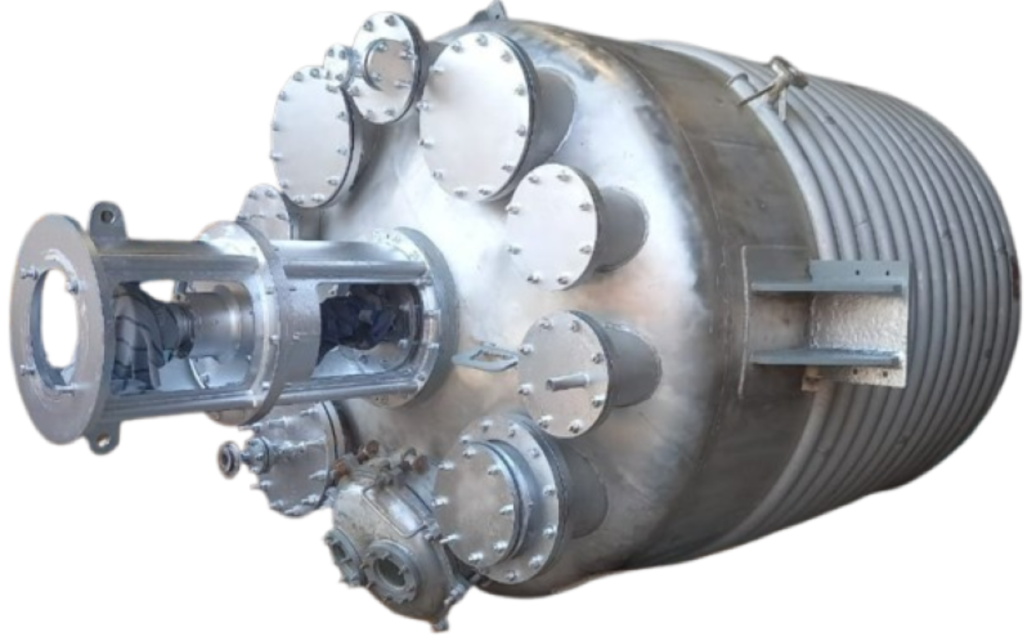
Project Data That Defines the Vessel
| Design Input | What It Defines |
|---|---|
| Process Duty & Capacity | Vessel size, working volume and overall configuration. |
| Operating Conditions | Design basis for temperature, pressure or vacuum. |
| Material Requirements | Suitable material of construction based on service conditions. |
| Heating / Cooling Duty | Jacket, limpet coil or other verified thermal arrangement. |
| Agitation Requirement | Agitator mounting, shaft arrangement, impeller or stage interface and sealing requirements. |
| Nozzles & Openings | Inlet, outlet, vent, manway, instrumentation and other process connections. |
| Inspection & Testing | Project-specific examination, testing and documentation requirements. |
Engineering note: Final vessel configuration is confirmed from the complete project design basis and applicable engineering requirements.
Materials of Construction for Reactor Vessels
SV Industries manufactures reactor vessels in materials selected according to process media, operating conditions, corrosion considerations, product-contact requirements and project-specific fabrication needs. The final material of construction is reviewed together with the vessel design basis before the specification is confirmed.
Common Construction Options
Stainless Steel
Stainless steel reactor vessels may be selected where corrosion resistance, cleanability, product-contact requirements or surface-finish requirements are important to the process.
Carbon Steel
Carbon steel reactor vessels may be considered for suitable services where process compatibility and project requirements allow its use.
Glass-Lined Reactor Vessels
Glass-lined reactor vessels may be selected for services where corrosion resistance and a non-reactive internal surface are important to the application.
PTFE-Lined Reactor Vessels
PTFE-lined reactor vessels may be considered where the process requires an additional corrosion-resistant lining suited to the service conditions.
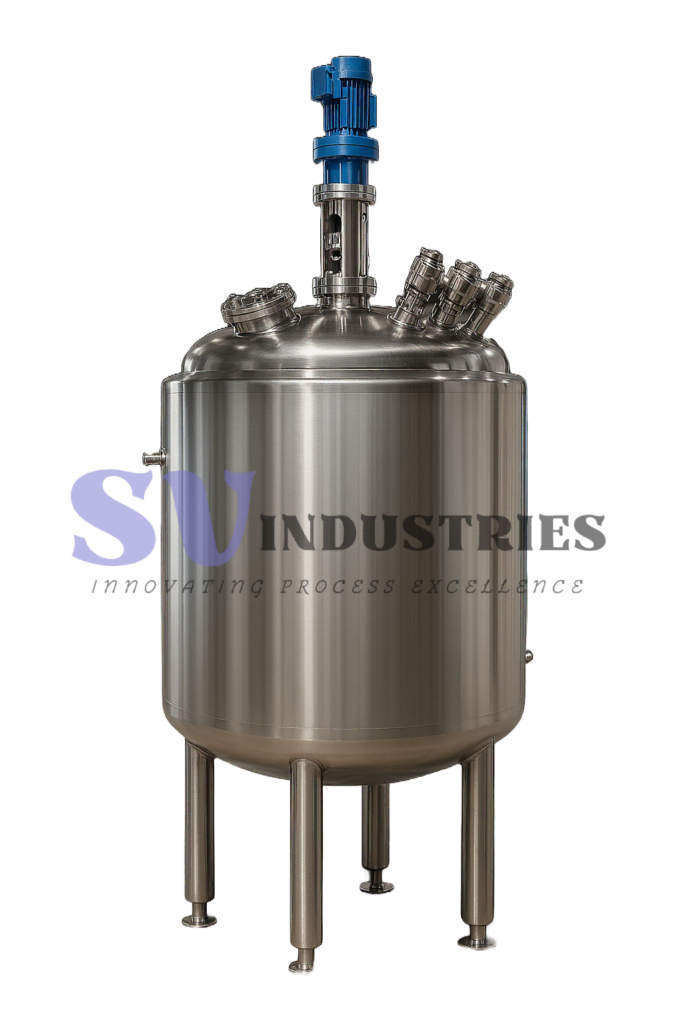
Material Selection Factors
- Process medium and composition
- Operating and design temperature
- Pressure or vacuum conditions
- Corrosion considerations
- Product-contact and cleaning requirements
- Surface-finish or lining requirements
- Fabrication and welding considerations
- Inspection and documentation requirements
Engineering note: Material selection is application-specific. Final material grades, lining requirements, corrosion allowance, surface finish and construction details are confirmed from the project design basis.
Heating & Cooling Arrangements for Reactor Vessels
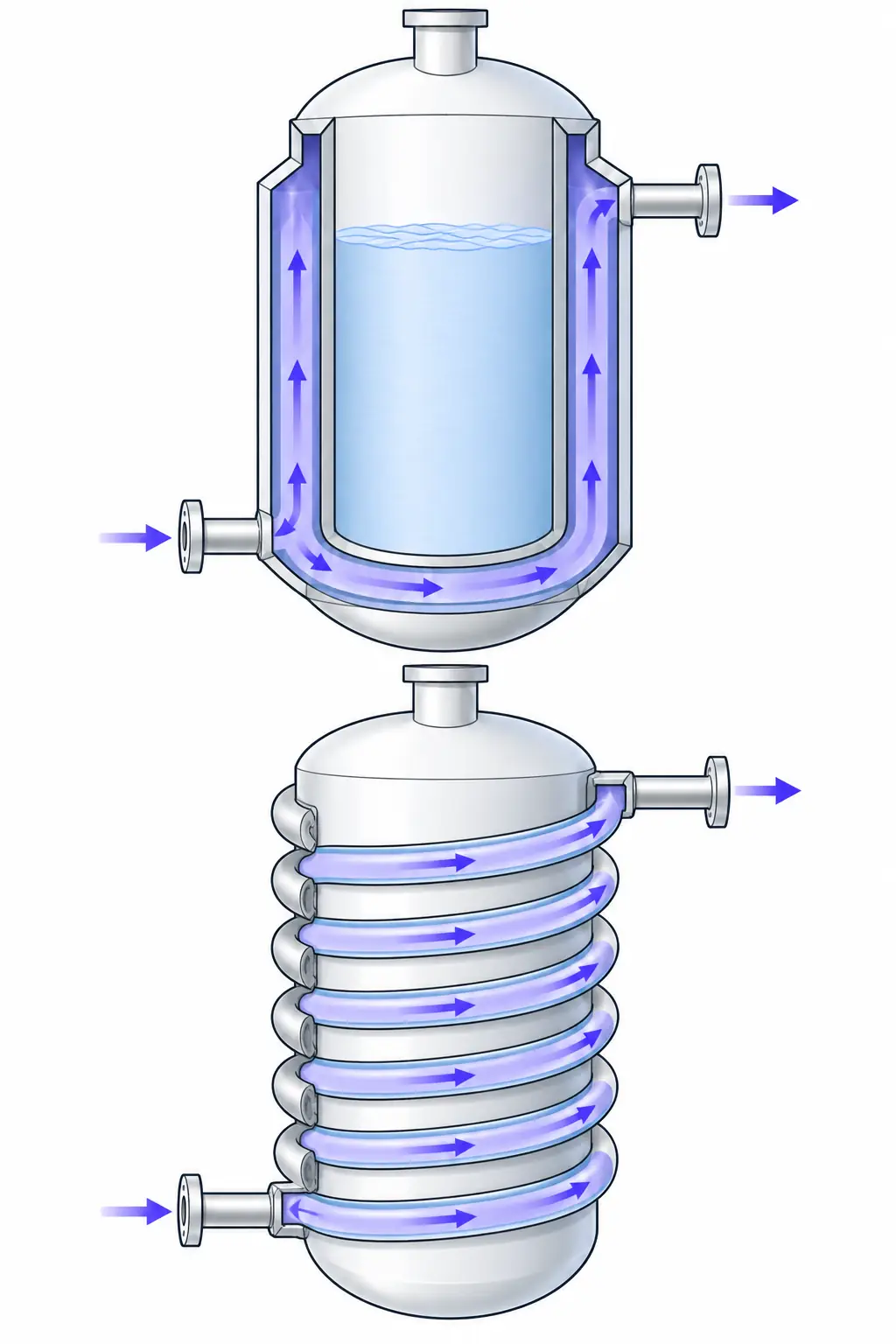
Top: Conventional Jacket
Bottom: Limpet / Half-Pipe Coil
Thermal Arrangement Options
Conventional Jacket
A conventional jacket may be provided around the vessel shell or other specified vessel surfaces where the project requires circulation of a heating or cooling medium.
Limpet / Half-Pipe Coil
A limpet or half-pipe coil may be arranged on the vessel shell and, where required by the project, extended to suitable head surfaces for circulation of the heating or cooling utility.
Project-Specific Thermal Arrangement
Where the process requires a different heating or cooling configuration, the arrangement is reviewed against the required duty, available utilities and vessel construction.
Thermal Design Inputs
- Required heating or cooling duty
- Process and utility temperatures
- Heating or cooling medium
- Available utility pressure
- Vessel area available for heat transfer
- Batch or process operating cycle
- Jacket or coil coverage requirement
- Insulation requirement where applicable
Engineering note: Jacket, limpet coil and other thermal arrangements are selected from the process duty and project design basis. Final configuration and utility conditions are confirmed during engineering review.
Agitator Integration for Reactor Vessels
Agitation may form an integral part of a reactor vessel depending on the process duty. The vessel and agitator interfaces are reviewed together so that mounting, shaft arrangement, impeller stages, sealing requirements, clearances and mechanical loads are considered during the overall equipment configuration.
Key Agitator Integration Considerations
Mounting & Drive Interface
The vessel top arrangement is coordinated with the agitator mounting, drive interface and required access for assembly or maintenance.
Shaft & Stage Arrangement
Shaft length, number of impeller stages and their positions are reviewed against the vessel geometry and operating liquid level.
Impeller Selection
Impeller type and configuration are selected according to the mixing duty and process requirements rather than from a single standard arrangement.
Sealing & Vessel Interface
Seal arrangement and agitator-vessel interfaces are confirmed from the process conditions and project requirements.
Loads & Internal Clearances
Agitator loads, internal clearances and interaction with vessel internals or nozzles are considered during the equipment layout.
Information Required for Agitator Integration
- Process and mixing duty
- Operating liquid level
- Product properties relevant to mixing
- Solids or gas involvement where applicable
- Required number of stages
- Vessel geometry and internal clearances
- Seal or containment requirements
- Available vessel mounting arrangement
- Project-specific operating conditions
Engineering note: Final agitator configuration is selected from the process duty and vessel design basis. Impeller type, number of stages, shaft arrangement, sealing and mounting details are confirmed during engineering review.
Nozzles, Openings & Process Connections
Reactor vessel nozzles and openings are arranged according to the process flow, utility connections, instrumentation, access requirements and equipment interfaces of the project. Their location, orientation and connection details are coordinated with the vessel geometry, agitation system and other internal or external components.
Connection Categories
Nozzle & Opening Arrangement
Nozzle orientation and elevation are reviewed together with the vessel shell, heads, agitator shaft, internals, jacket or limpet coil coverage and available maintenance space. The final arrangement is coordinated from the approved project requirements and equipment layout.
Design basis: No fixed nozzle schedule is assumed before the process and piping requirements are reviewed.
Information Used for Connection Planning
- Process connection purpose
- Required connection size and type
- Piping orientation
- Utility connections
- Instrument requirements
- Manway or access requirement
- Agitator and internal clearances
- Jacket or limpet coil interference
- Drainability and maintenance access
- Project-specific connection standards
Engineering note: Final nozzle sizes, connection types, locations, orientations and reinforcement requirements are confirmed from the process data, piping requirements, vessel design basis and applicable engineering requirements.
Reactor Vessel Construction & Fabrication
Reactor vessel fabrication brings the approved design basis into the final equipment configuration. Shells, heads, openings, supports, thermal arrangements and agitator interfaces are coordinated during fabrication so that the completed vessel reflects the project-specific construction requirements.
Typical Fabrication Sequence
Material Preparation
Approved construction materials are prepared according to the vessel component requirements and fabrication plan.
Shell & Head Fabrication
Shell courses and heads are formed, prepared and assembled to the required vessel geometry.
Fit-Up & Welding
Vessel components, nozzles, supports and other fabricated parts are aligned and joined according to the approved construction requirements.
Equipment Integration
Jackets or limpet coils, agitator interfaces, nozzles, manways and other project-specific features are incorporated into the vessel assembly.
Finishing & Inspection Preparation
The completed fabrication is prepared for the specified surface finishing, examination, testing and final quality checks.
Construction Details Coordinated During Fabrication
- Shell and head geometry
- Nozzle and opening locations
- Supports and mounting details
- Jacket or limpet coil arrangement
- Agitator mounting interface
Project-Specific Fabrication Features
- Manways and access openings
- Internal attachments where applicable
- Surface-finish requirements
- Insulation or cladding interfaces where applicable
- Inspection and testing preparation
Engineering note: Final fabrication details are governed by the approved project drawings, vessel design basis, material requirements and applicable inspection or testing requirements.
Inspection, Testing & Quality Assurance
Inspection and testing requirements are defined from the reactor vessel design basis, construction requirements and project documentation needs. Fabrication stages and completed equipment are reviewed against the specified inspection and testing scope before final release.
Quality Checks Before Release
- Approved drawing / specification review
- Vessel dimensions and orientation
- Nozzle and opening verification
- Support and mounting details
- Jacket / limpet coil connections where applicable
- Agitator interface verification
- Surface-finish requirements where specified
- Final inspection status
Project Documentation
- Inspection and testing records
- Material documentation where required
- Pressure-test records where applicable
- Examination reports where specified
- Approved drawings / project documents
- Other client-required documentation
Engineering note: Inspection, testing and documentation requirements are project-specific. The final quality plan is confirmed from the vessel design basis, approved drawings and agreed inspection scope.
Reactor Vessel Applications Across Process Industries
Reactor vessels are configured for different process duties depending on the product, operating conditions, mixing requirements and thermal needs of the application. SV Industries supplies custom reactor vessel configurations for a range of industrial processing requirements.
Chemical & Specialty Chemicals
For reaction, blending, dissolution, neutralization and other controlled chemical-processing duties.
Pharmaceutical Processing
For project-specific processing duties requiring controlled mixing, heating, cooling or product-contact construction.
Food & Beverage Processing
For suitable mixing, cooking, heating, cooling and formulation applications where hygienic construction requirements are specified.
Dyes, Pigments & Coatings
For reaction, dispersion, blending and preparation duties used in colorant and coating processes.
Water & Wastewater Treatment
For neutralization, chemical preparation, dosing-related processing and other treatment applications.
Agrochemicals & Fertilizers
For formulation, blending and reaction duties associated with agricultural chemical processing.
Adhesives, Resins & Polymers
For resin preparation, blending and other project-specific reaction or thermal-processing duties.
Cosmetics & Personal Care
For formulation, blending and temperature-controlled processing where product-contact and cleaning requirements are important.
Information Required for a Reactor Vessel Quotation
Providing the key process and equipment requirements helps us review the reactor vessel configuration more effectively. Complete information is not mandatory at the initial enquiry stage; available project data can be shared first and remaining details can be reviewed during technical discussion.
Key Project Information
Process Duty
Reaction, blending, dissolution, formulation or other intended process duty.
Required Capacity
Working volume or required batch quantity, together with any known gross-volume requirement.
Operating Conditions
Available operating and design temperature, pressure or vacuum information.
Process Medium
Product or chemical handled, including relevant properties or corrosion considerations where known.
Material of Construction
Preferred material or lining requirement, if already specified.
Heating / Cooling Requirement
Heating, cooling or combined duty, along with available utility details where known.
Agitation Requirement
Known mixing duty, agitator preference or existing process information relevant to agitation.
Nozzles & Connections
Required process, utility, instrumentation, charging, discharge and access connections where available.
Helpful Supporting Information
- Vessel orientation preference
- Available installation space
- Head or support preference, if specified
- Surface-finish requirement
- Insulation or cladding requirement
- Inspection or testing requirement
- Applicable project standard or client specification
- Existing GA drawing, sketch or datasheet if available
- Site or piping constraints relevant to the vessel
Not all information needs to be finalized before contacting us. Preliminary requirements are sufficient to begin the technical review.
For faster technical review: Include the available process duty, capacity, operating conditions, material requirement and heating/cooling or agitation details in your enquiry.
Reactor Vessel Design & Fabrication FAQs
What information is required to design a custom reactor vessel?
The initial design review typically considers the process duty, required capacity, operating and design conditions, process medium, material requirements, heating or cooling duty, agitation requirements, nozzles and project-specific inspection or documentation needs. Preliminary information is sufficient to begin the discussion.
What materials of construction are available for reactor vessels?
Reactor vessels may be manufactured in stainless steel, carbon steel, glass-lined or PTFE-lined construction depending on the project requirements. Final material selection is confirmed from the process medium, operating conditions, corrosion considerations and product-contact requirements.
Can a reactor vessel be designed for pressure or vacuum service?
Yes. Pressure or vacuum requirements are considered as part of the vessel design basis. The final construction depends on the specified design conditions, material, geometry and applicable engineering requirements.
What heating and cooling arrangements can be provided?
Depending on the process duty, reactor vessels may use a conventional jacket, limpet / half-pipe coil or another project-specific thermal arrangement. Utility conditions, vessel geometry and available heat-transfer area are reviewed during engineering.
Can an agitator be integrated with the reactor vessel?
Yes. Agitator mounting, shaft arrangement, number of stages, impeller configuration, sealing, internal clearances and vessel interfaces can be coordinated with the reactor vessel design.
What nozzles and openings can be provided?
Process inlet and outlet connections, charging and discharge connections, utility nozzles, instrumentation ports, vents, drains, manways and other project-required openings can be incorporated according to the approved equipment layout.
What inspection and testing can be included?
Depending on the agreed project scope, inspection may include dimensional and visual checks, pressure or leak testing and specified non-destructive examination. Final requirements are confirmed from the approved inspection scope and vessel design basis.
What should I send to request a reactor vessel quotation?
Share the available process duty, capacity, process medium, temperature, pressure or vacuum conditions, preferred material, heating or cooling requirements, agitation details and required connections. Drawings, datasheets or sketches can also be provided where available.
Related Reactor Vessel & Mixing Equipment
Review related reactor vessel configurations and agitation systems that may form part of a complete process equipment requirement.
01
Industrial Agitator
Agitator systems configured for blending, suspension, heat transfer and other process mixing duties.
02
SS Jacketed Vessel
Stainless steel jacketed vessels for process heating, cooling and mixing duties, with suitable agitator integration based on the required application.
03
Limpet Coil Reactor Vessel
Reactor vessels with external limpet or half-pipe coil arrangements for process temperature control, with agitator configuration coordinated with the vessel design.
04
Industrial Chemical Reactor
Industrial chemical reactor configurations for project-specific reaction, mixing and thermal-processing requirements.
Need a Reactor Vessel for Your Process?
Share your process duty, required capacity, operating conditions, material requirements, heating or cooling needs, agitation details and any available datasheet or drawing with our team for technical review.