
Anchor Impeller Manufacturer
SV Industries manufactures custom anchor impellers and anchor agitators in Ahmedabad, Gujarat, India, for industrial tanks, mixing vessels and reactors. The close-clearance anchor blade geometry supports material movement near vessel walls and is considered for viscous products such as adhesives, creams, gels and pastes.
Each industrial anchor mixer is configured according to vessel geometry, fluid characteristics, operating conditions and the required mixing duty. Stainless steel construction and customized blade arrangements are selected to suit application-specific processing requirements, including suitable temperature-controlled mixing duties.
What Is an Anchor Impeller?
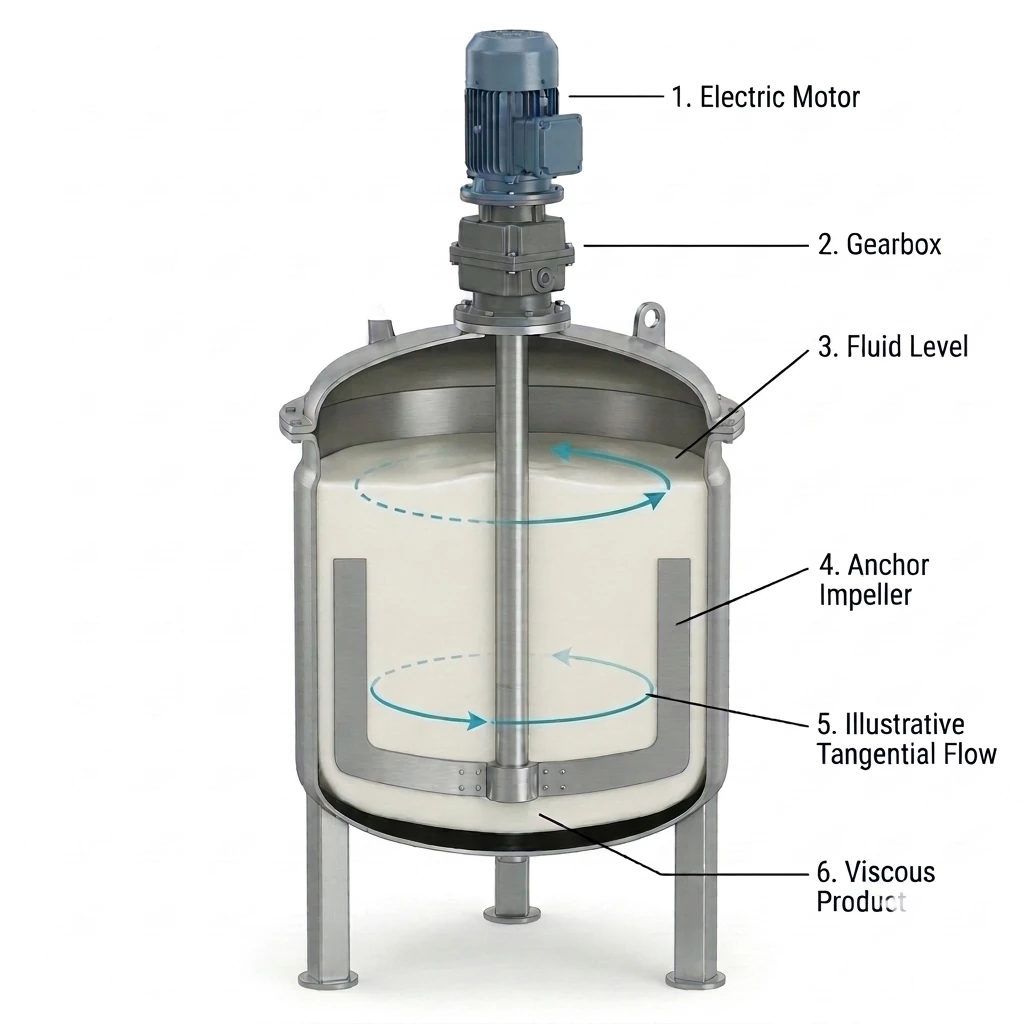
An anchor impeller is a large-diameter, close-clearance mixing element used in industrial agitators for viscous liquids, creams, gels, pastes and similar products. Its open, anchor-shaped blades rotate close to the vessel wall, encouraging material movement around the tank during low-speed mixing operations.
Unlike high-speed impellers that generate strong axial or radial circulation, a conventional anchor impeller primarily produces tangential, wall-following movement. It is commonly considered for viscous batch mixing in process vessels, chemical reactors and temperature-controlled mixing applications.
Mixing performance depends on fluid rheology, vessel geometry, blade clearance and operating conditions. Where stronger circulation through the vessel centre or physical wall wiping is required, modified anchor configurations, additional mixing elements or dedicated scrapers may be considered.
Near-Wall Material Movement
Close-clearance anchor blades support movement of viscous material near the vessel wall.
Controlled Viscous Mixing
Suitable for selected low-speed batch mixing operations where gentle bulk movement is required.
Application-Specific Configuration
Impeller geometry and arrangement are selected according to vessel design, product characteristics and process duty.
How Does an Anchor Impeller Work?
An anchor impeller works by rotating at relatively low speed inside a vessel while its close-clearance blades travel near the inner wall. This movement helps displace viscous material around the tank and promotes bulk circulation during batch mixing.
In a conventional anchor configuration, the dominant movement is mainly tangential and wall-following rather than a strong axial pumping pattern. This makes anchor impellers suitable for selected viscous mixing duties where controlled, low-shear movement is preferred.
Actual mixing performance depends on factors such as fluid viscosity, vessel shape, blade clearance, liquid level and operating speed. Where improved centre-zone circulation or wall wiping is required, the anchor impeller may be combined with modified internal elements or scraper arrangements.
Low-Speed Rotation
The anchor impeller rotates at controlled speed to handle viscous material without creating unnecessarily aggressive mixing action.
Near-Wall Material Movement
The close-clearance blade path supports material movement near the vessel wall, where viscous layers often build up during processing.
Bulk Circulation in the Vessel
As the anchor rotates, it promotes circumferential material movement and supports bulk turnover within the vessel. The extent of circulation depends on fluid characteristics, vessel geometry and operating conditions.
Application-Specific Enhancement
Where process requirements are more demanding, the anchor arrangement may be paired with scrapers or other internal elements for improved duty performance.
Anchor Impeller Types and Blade Configurations
Anchor impellers can be configured with different blade arrangements and optional mixing elements to suit specific industrial applications. Selection depends on product viscosity, vessel geometry, mixing objectives and operating conditions.
At SV Industries, anchor impeller design is approached according to the required process duty, including near-wall material movement, possible wall-wiping requirements and the need for additional internal circulation.
Standard Flat-Plate Anchor Impeller
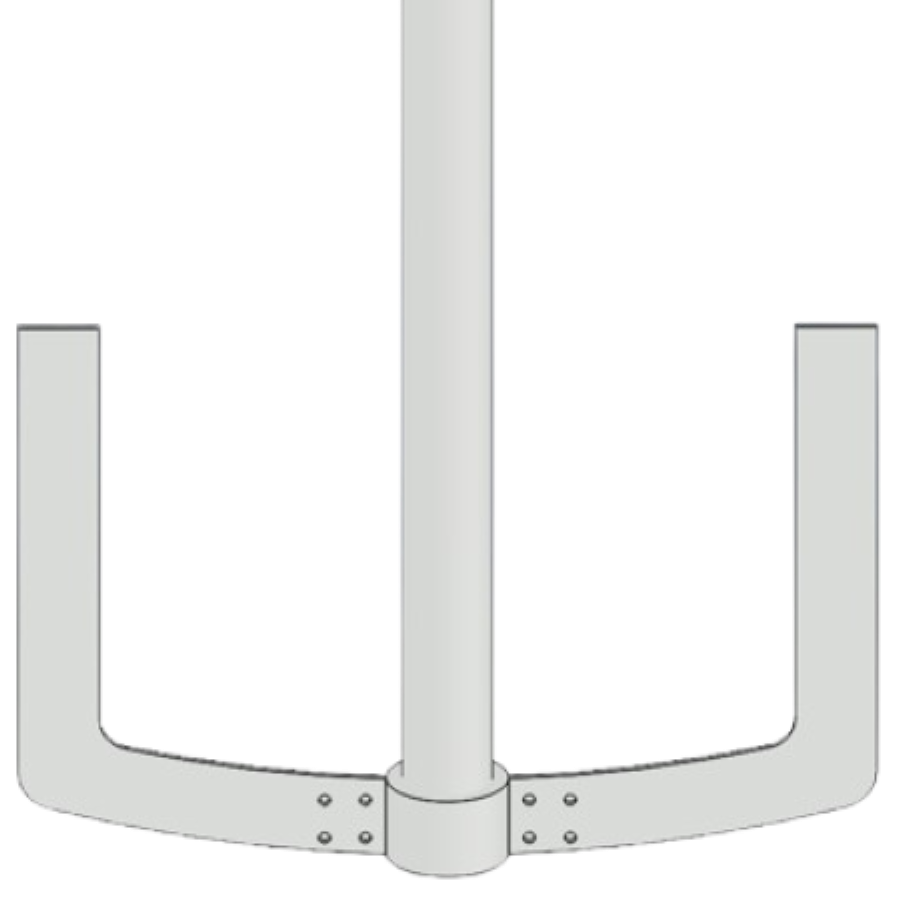
A conventional anchor impeller features a large, U-shaped blade arrangement with flat-plate sections positioned close to the vessel wall. The outer blades are connected to a central shaft and support predominantly tangential material movement during viscous batch mixing.
This configuration is considered for applications involving creams, gels, resins and other viscous products where controlled near-wall movement is required.
Anchor Impeller with Scrapers
For processes where viscous or adhesive products tend to accumulate on vessel walls, an anchor impeller may be equipped with specially designed scraper or wiper elements.
These components provide physical wall wiping and may help reduce product buildup during selected mixing and heat-transfer duties. Scraper materials, mounting arrangements and compatibility must be evaluated according to the process conditions.
Unlike a conventional anchor, a scraper-equipped anchor includes dedicated components for wall contact.
Gate-Type and Modified Anchor Configurations
Gate-type and modified frame arrangements use additional structural or mixing members to influence material movement within the vessel.
These configurations differ from a classical U-shaped anchor and may be considered where the standard blade geometry does not provide the required movement through the batch.
The appropriate arrangement depends on fluid behaviour, vessel geometry, mechanical loading and the intended mixing duty.
Custom and Combined Anchor Mixing Arrangements
Some processes require both near-wall material movement and additional circulation within the central region of the vessel.
For these applications, modified anchor blades, supplementary paddles or combined mixing arrangements may be evaluated through project-specific engineering review.
Such configurations require consideration of the complete agitator assembly, including the shaft, drive system, mechanical clearances and process requirements.
Application note: Anchor impellers may also be considered for jacketed reactors and temperature-controlled vessels. Jacket compatibility is an application-specific consideration rather than a separate basic impeller type.
Anchor Impeller Design, Materials and Construction
Anchor impeller construction involves the selection of suitable blade geometry, shaft arrangement, fabrication materials and surface finish for the intended mixing application. These features influence mechanical integrity, material movement, vessel compatibility and long-term operating suitability.
SV Industries manufactures stainless steel anchor impellers for industrial agitators and process vessels, with configurations selected according to vessel dimensions, product characteristics and operating requirements.
Anchor Blade Geometry and Construction
Anchor blades are commonly fabricated from stainless steel flat plates arranged in a large U-shaped or vessel-contour-following profile. Their geometry supports near-wall material movement during viscous mixing operations.
Blade width, arrangement and vessel clearance are considered according to the required mixing duty. Modified blade configurations may be evaluated where the application calls for additional material movement.
Shaft and Mechanical Connections
The anchor blade assembly is connected to a central agitator shaft through suitable structural supports and mounting connections.
Shaft construction, attachment details and the complete rotating assembly must be evaluated for the mechanical demands of the intended process, including fluid resistance, operating speed and required torque.
Vessel Fit and Blade Clearance
The anchor blade profile is configured with consideration for the vessel's internal diameter, cylindrical wall and bottom-head geometry.
Appropriate clearance between the rotating blades and vessel surfaces is essential for mechanical operation. Conventional close-clearance anchors do not automatically provide physical wall scraping; dedicated scraper elements are required where wall wiping is part of the process duty.
Stainless Steel Material Options
A commonly used material for general industrial anchor impellers where its mechanical properties and corrosion resistance are suitable for the specified process environment.
Molybdenum-containing stainless steel grades considered for applications requiring improved resistance to certain corrosive environments. Final suitability depends on chemical composition, concentration, temperature and operating conditions.
Alternative materials or special construction requirements may be evaluated according to the application and confirmed manufacturing scope.
Surface Finish and Fabrication Considerations
Surface finishing requirements depend on the product being processed, cleaning expectations and operating environment. Depending on the approved project specification, suitable options may include standard fabricated finishes, mechanical polishing or other specified surface treatments.
Material selection, fabricated connections, surface finishing and applicable inspection requirements should be established during project-specific engineering review.
Anchor Impeller Technical Specifications and Customization
SV Industries manufactures custom anchor impellers for industrial agitators, mixing tanks and reactor vessels. Each anchor impeller configuration is selected according to vessel dimensions, product characteristics, mixing requirements and operating conditions.
Technical specifications such as impeller diameter, shaft size, blade construction, operating speed and material of construction are established for the intended application rather than assigned as universal values. Scraper arrangements, surface finishing and integration with complete agitator systems may also be considered according to project requirements.
| Specification | Design and Selection Basis |
|---|---|
| Impeller Type | Conventional flat-plate anchor or a project-specific modified configuration. |
| Impeller Diameter | Selected according to vessel internal diameter, blade arrangement and required operating clearance. |
| Anchor Blade Geometry | U-shaped or vessel-contour-following flat-plate construction, with blade dimensions suited to the mixing duty. |
| Shaft Diameter and Supports | Selected according to mechanical loading, required torque, operating speed and complete agitator configuration. |
| Operating Speed | Application-specific low-speed mixing arrangement, evaluated according to fluid behaviour and process requirements. |
| Vessel Capacity and Dimensions | Custom configuration based on vessel dimensions, working volume, liquid level and internal geometry. |
| Viscosity Handling | Suitability evaluated from fluid viscosity, rheology, operating conditions and the intended mixing objective. |
| Material of Construction | SS304, SS316 or SS316L as applicable, with material compatibility confirmed for the process environment. |
| Scraper Arrangement | Optional scraper or wiper configuration where physical wall wiping is required, subject to separate engineering review. |
| Drive and Shaft Sealing | Motor, gearbox, mounting and sealing arrangements evaluated as part of the complete agitator and vessel system. |
| Operating Temperature and Pressure | Considered according to the process duty, material selection, vessel interface and mechanical design requirements. |
| Surface Finish | Standard fabricated or specified mechanically finished surfaces according to project and cleaning requirements. |
Anchor Impeller Customization Options
- Blade Configuration: Flat-plate geometry, blade width, profile and vessel-contour compatibility.
- Material Selection: Stainless steel grades and alternative material requirements subject to review.
- Scraper Provision: Wall-wiping components where required by the process.
- Surface Finish: Mechanical finishing and polishing according to the approved specification.
- Agitator Integration: Shaft, mounting, drive and sealing considerations for the complete system.
Information for Technical Enquiry
- Vessel Details: Internal diameter, height, bottom-head type and available vessel drawing.
- Batch Details: Working volume, minimum and maximum liquid levels and process type.
- Product Characteristics: Product name, viscosity or rheology information and specific gravity.
- Operating Conditions: Temperature, pressure, mixing objective and heating or cooling requirements.
- Construction Requirements: Preferred material, finish, scraper requirement and existing drive details, where available.
Engineering Note: The specifications above are selection considerations, not fixed performance ratings. Final dimensions, materials and operating requirements are established for each project. Share your technical requirements with SV Industries for a custom quotation.
Anchor Impeller Applications for High-Viscosity Mixing
Anchor impellers are used in selected industrial mixing applications involving viscous liquids, creams, gels, resins, pastes and other products requiring controlled material movement near vessel walls. Their close-clearance blade geometry makes them relevant to batch processes where low-speed agitation and vessel-wall movement are important.
SV Industries provides application-specific anchor impeller configurations for industrial mixing tanks and reactors. The appropriate arrangement depends on product viscosity, rheology, vessel geometry, operating temperature and the intended processing duty. Additional scrapers or mixing elements may be considered where required.
Chemical & Specialty Chemical Processing
Anchor impellers may be considered for chemical processing applications involving viscous resins, polymer solutions and specialty chemical intermediates. Their close-clearance geometry supports controlled material movement near the vessel wall during selected batch mixing operations.
Typical products: Resins, polymer solutions, viscous chemical blends and process pastes.
Selection consideration: Fluid rheology, changing batch viscosity, chemical compatibility and process temperature.
Pharmaceutical & Fine Chemical Processing
Selected pharmaceutical and fine chemical processes involve viscous formulations that may benefit from controlled, low-speed anchor mixing. Appropriate configurations can be evaluated for ointment bases, gels and other semi-solid processing duties.
Typical products: Ointment bases, topical gels, viscous intermediates and selected semi-solid formulations.
Selection consideration: Product sensitivity, material compatibility, cleanability, surface finish and applicable hygienic requirements.
Food & Beverage Processing
Anchor mixing arrangements may be evaluated for thick food products where controlled material movement is required during batching, blending or temperature-controlled processing. Equipment selection depends on the food product and process duty.
Typical products: Thick sauces, concentrated syrups, food creams and selected viscous food preparations.
Selection consideration: Product viscosity, food-contact material suitability, cleaning requirements and thermal processing conditions.
Cosmetics & Personal Care
Cosmetics and personal care manufacturing often involves viscous creams, lotions and gels. Anchor agitators may be considered for selected mixing stages requiring controlled movement of these formulations within process vessels.
Typical products: Skin creams, body lotions, hair-care gels, body butters and cosmetic bases.
Selection consideration: Product rheology, temperature sensitivity, cleaning needs and possible requirements for additional dispersion or emulsification equipment.
Paints, Coatings & Adhesives
Anchor impellers may be used in selected viscous paint, coating and adhesive-processing duties where near-wall material movement is important. Scraper-equipped or combined mixing arrangements may be evaluated for products that tend to adhere to vessel surfaces.
Typical products: Viscous coating bases, adhesives, resin-rich formulations and selected industrial pastes.
Selection consideration: Product viscosity, solids content, dispersion requirements, adhesion behaviour and mechanical loading.
Application Selection Note: The product examples above indicate potential anchor impeller applications, not guaranteed mixing performance. Final impeller selection depends on actual fluid behaviour, vessel design, operating conditions and the required mixing objective. Processes requiring high-shear dispersion, intensive emulsification or stronger axial circulation may need additional mixing elements or an alternative agitator arrangement.
Anchor Agitators for Jacketed Reactors and Vessels
Anchor agitators may be considered for jacketed reactors and limpet coil vessels handling viscous products during heating, cooling and temperature-controlled batch processing. Their close-clearance blade arrangement supports material movement near the vessel wall, where heat is exchanged between the process and the external thermal system.
In applications involving resins, creams, gels, pastes and other viscous materials, anchor impeller selection depends on product rheology, vessel geometry, operating temperature and the required heating or cooling duty. Additional scraper elements or combined mixing arrangements may be evaluated where wall deposits or insufficient internal circulation present processing challenges.
Near-Wall Material Movement
In a jacketed reactor, heating or cooling takes place through the vessel wall. A conventional anchor impeller promotes material movement close to this surface as its blades rotate through the batch.
This near-wall movement may influence product-side heat transfer and help redistribute material exposed to temperature-controlled vessel surfaces. The result depends on actual fluid characteristics and process conditions.
Heating and Cooling of Viscous Products
Viscous products can present additional mixing challenges during heating and cooling, particularly when viscosity changes with temperature or material tends to accumulate near vessel walls.
Anchor agitation may be considered for selected temperature-controlled batch processes. Where physical wall wiping or stronger internal circulation is required, dedicated scrapers or supplementary mixing elements may need to be evaluated.
Anchor Agitators in Jacketed Vessels
Conventional jacketed vessels use an external jacket through which a heating or cooling utility circulates. Where viscous process-side mixing is required, an anchor agitator may be considered as part of the complete vessel arrangement.
Agitator selection must account for the product, jacketed surface, internal vessel geometry and the required temperature-controlled duty.
Explore SS Jacketed VesselsAnchor Agitators in Limpet Coil Reactors
Limpet coil reactor vessels use external coils or half-pipe channels attached to the vessel surface for indirect heating or cooling.
Where an anchor agitator is selected, its process-side mixing arrangement must be coordinated with the vessel geometry, fluid behaviour and thermal duty. The external coil configuration does not independently determine the appropriate impeller type.
Explore Limpet Coil Reactor VesselsEngineering Note: An anchor impeller does not independently guarantee uniform vessel temperature, a particular heating or cooling time, or freedom from wall deposits. Actual performance depends on fluid behaviour, mixing conditions, thermal surfaces and utility operation. Conventional anchor blades do not provide physical wall scraping unless dedicated scraper components are fitted.
Anchor Impeller vs Other Industrial Impellers
Anchor impellers, helical ribbon impellers, pitched blade turbines and Rushton turbines generate different fluid-flow patterns and are selected for different industrial mixing duties. Understanding these differences helps identify a suitable agitator configuration for viscous blending, bulk circulation, solids suspension or gas dispersion.
A conventional anchor impeller is commonly considered where controlled near-wall movement of viscous products is important. Other impeller geometries may be more appropriate when the process requires stronger axial circulation, solids suspension or gas–liquid contacting. Final selection depends on fluid rheology, vessel geometry, operating conditions and the required mixing objective.
Industrial Impeller Selection Comparison
| Impeller Type | Dominant Flow Pattern | Typical Mixing Duty and Selection |
|---|---|---|
| Anchor Impeller | Tangential / Circumferential Predominantly near-wall material movement. | Considered for viscous liquids, creams, gels, resins and pastes where controlled movement near the vessel wall is important. Selection consideration: Conventional anchors may provide limited centre-zone circulation. Physical wall wiping requires dedicated scrapers. |
| Helical Ribbon Impeller Helical Impeller Details | Axial and Circumferential Circulation depends on ribbon geometry and rotation direction. | Considered for viscous products where circulation between upper and lower vessel regions is an important mixing objective. Selection consideration: Ribbon configuration, viscosity, vessel clearances and mechanical loading require application-specific evaluation. |
| Pitched Blade Turbine Pitched Blade Turbine Details | Predominantly Axial Flow direction and radial contribution vary with blade design. | Commonly considered for bulk liquid blending and selected solids-suspension duties where through-vessel circulation is needed. Selection consideration: Blade pitch, pumping direction, viscosity and vessel internals influence suitability. |
| Rushton Turbine Rushton Turbine Details | Radial Outward flow from the impeller with localized shear. | Commonly considered for gas-liquid dispersion and selected mixing duties where radial flow and local shear are required. Selection consideration: Gas loading, fluid properties, power demand and vessel configuration require review. |
How to Choose the Right Impeller
The appropriate impeller depends on the primary mixing objective. Where near-wall movement of a viscous product is important, an anchor arrangement may be considered. A helical ribbon may be evaluated when additional circulation through the vessel is required.
For selected liquid-blending and solids-suspension applications, a pitched blade turbine may be more appropriate. Processes involving gas dispersion or a specific radial mixing requirement may call for a Rushton turbine or another suitable impeller arrangement.
Final selection should consider viscosity and rheology, working volume, vessel geometry, process conditions, shear sensitivity and the required mixing result.
Engineering Note: The comparison above describes typical mixing characteristics, not universal performance rankings. Actual flow, power demand and mixing results depend on the complete equipment and process arrangement. See our Industrial Agitator Systems or discuss your mixing application with SV Industries.
Benefits and Selection Considerations of Anchor Impellers
Anchor impellers offer practical advantages for selected viscous mixing applications, particularly where controlled agitation and material movement near vessel walls are important. Their large-diameter, close-clearance construction makes them relevant to industrial mixing tanks, reactors and temperature-controlled batch processing.
However, selecting an anchor agitator requires more than identifying the product viscosity. Fluid rheology, circulation requirements, vessel geometry, torque demand and process conditions must be considered to determine whether a conventional anchor, scraper-equipped configuration or alternative impeller arrangement is appropriate.
Key Benefits of Anchor Impellers
-
Near-Wall Material Movement
The large-diameter, close-clearance blade arrangement promotes material movement near the vessel wall during selected viscous mixing operations.
-
Controlled Low-Speed Agitation
Anchor impellers are commonly operated at relatively low speeds, making them relevant to processes requiring gentle bulk movement. Local shear near the blade and wall clearance still requires consideration.
-
Support for Temperature-Controlled Mixing
Near-wall material movement can be useful in jacketed vessels and reactors during heating or cooling of viscous products. Actual thermal performance depends on the complete process arrangement.
-
Application-Specific Construction
Blade geometry, construction materials, surface finishing and optional scraper arrangements can be evaluated to suit different vessel configurations and mixing requirements.
Important Selection Considerations
-
Centre-Zone Circulation
Conventional anchor impellers may provide limited circulation through the central vessel region. Processes requiring stronger axial mixing may need additional mixing elements or another impeller type.
-
Fluid Rheology and Viscosity Changes
Mixing performance depends on actual fluid behaviour, including shear-thinning characteristics and viscosity changes during processing. No universal viscosity limit applies to every anchor arrangement.
-
Shaft Torque and Drive Requirements
Viscous mixing can impose substantial torque and mechanical loading even at low operating speeds. Shaft construction, gearbox selection and drive suitability require evaluation.
-
Wall Scraping and Mechanical Clearance
A conventional anchor does not automatically scrape the vessel wall. Where product deposits require physical wiping, suitable scraper components and compatible clearances must be considered.
-
Vessel Geometry and Cleaning
Blade profile, vessel internals, bottom-head shape, liquid level and cleaning requirements may influence the final arrangement.
When Should an Anchor Impeller Be Considered?
An anchor impeller may be suitable when the process involves viscous material and requires controlled movement near vessel walls. The configuration can also be evaluated for selected jacketed mixing duties where process-side material movement is important.
Where the primary objective involves intensive high-shear dispersion, gas dispersion or stronger axial circulation, other impeller designs or combined agitator arrangements may be more appropriate.
SV Industries can review the proposed mixing application using vessel details, fluid characteristics and operating requirements. Request an application-specific consultation .
Why Choose SV Industries for Anchor Impellers?
SV Industries is an Ahmedabad, Gujarat-based manufacturer of industrial agitators, reactor vessels and custom process equipment. Our manufacturing approach focuses on developing practical equipment configurations around the intended process, vessel dimensions, operating conditions and project requirements.
For anchor impeller applications, blade construction, material selection, shaft arrangements and mechanical integration are considered as part of the equipment requirement. From initial technical review through fabrication and applicable inspection, the manufacturing scope is coordinated according to the agreed project specifications.
Built Around Your Process Requirements
SV Industries manufactures industrial agitators, reactor vessels and custom process equipment for application-specific requirements.
Anchor impeller projects are considered in relation to the intended mixing duty, vessel dimensions and mechanical configuration.
- Project-specific equipment configuration
- Stainless steel fabrication and material selection
- Impeller, shaft and drive integration
- Agitator and process vessel manufacturing
- Inspection and documentation according to project scope
From Technical Requirement to Dispatch
Our project workflow connects requirement review, engineering, manufacturing and applicable inspection activities within the agreed supply scope.
-
01Requirement Review
Available vessel details, fluid characteristics, operating conditions and mixing objectives are reviewed to define the equipment requirement.
-
02Engineering and Configuration
The proposed anchor blade arrangement, construction materials, shaft connections and mechanical interfaces are considered according to the project duty.
-
03Fabrication and Assembly
Components are fabricated and assembled according to the approved construction details and agreed manufacturing scope.
-
04Inspection and Testing
Applicable manufacturing checks and inspection activities are carried out as required by the equipment and approved project specification.
-
05Documentation and Dispatch
Applicable project documents, packing and dispatch preparations are completed according to the agreed supply requirements.
Project-Specific Manufacturing: Anchor impeller dimensions, materials, fabrication details, inspection requirements and deliverables are defined according to the agreed project scope. Particular testing methods, certifications or documentation should not be assumed unless specified and confirmed.
Frequently Asked Questions About Anchor Impellers
What is the primary function of an anchor impeller?
An anchor impeller promotes controlled movement of viscous material near the walls of a mixing vessel. Its large-diameter, close-clearance blade arrangement is commonly considered for creams, gels, resins, pastes and other viscous products. Actual mixing performance depends on fluid properties, vessel geometry and operating conditions.
How does an anchor impeller work?
An anchor impeller rotates around a central shaft, with its outer blade sections positioned close to the vessel wall. A conventional anchor primarily produces tangential or circumferential material movement. Additional mixing elements may be required where stronger circulation through the vessel centre is needed.
Does an anchor impeller scrape the tank wall?
Not necessarily. A conventional anchor operates close to the vessel surface but does not automatically make physical contact with the wall. Where wall wiping is required, dedicated scraper or wiper components must be incorporated into the design.
Can anchor impellers handle both low and high-viscosity fluids?
Anchor impellers are commonly selected for viscous mixing applications, but suitability depends on more than viscosity alone. For low-viscosity blending, stronger axial circulation or solids suspension, other impeller configurations may be more appropriate.
Which industries use anchor impellers?
Anchor impellers may be used in chemical processing, pharmaceutical manufacturing, food processing, cosmetics, personal care, paints, coatings and adhesive production. Typical applications include viscous resins, creams, gels, ointment bases, sauces and industrial pastes.
Are anchor impellers suitable for jacketed and limpet coil reactors?
Yes, anchor impellers may be considered for jacketed reactors and limpet coil vessels handling viscous products during heating or cooling. Their near-wall movement can influence process-side heat transfer, but actual thermal performance depends on fluid behaviour, vessel geometry and operating conditions.
What materials are used to manufacture anchor impellers?
SS304, SS316 and SS316L stainless steel are commonly considered for anchor impeller construction. Material selection depends on chemical compatibility, corrosion conditions, operating temperature and project requirements. Alternative materials may also be evaluated.
How are anchor impeller diameter and operating speed selected?
Impeller diameter depends on vessel internal diameter, blade geometry and required mechanical clearance. Operating speed is selected according to product characteristics, mixing objectives, torque requirements and agitator configuration. There is no single diameter or RPM suitable for every application.
Do anchor impellers always reduce power consumption?
No. Although anchor impellers commonly operate at relatively low speeds, viscous mixing may require substantial torque and motor power. Energy consumption depends on fluid rheology, equipment geometry and operating conditions.
What affects the service life of an anchor impeller?
Service life depends on material compatibility, mechanical loading, operating conditions, fabrication quality and maintenance. Regular inspection of blade condition, shaft connections, mechanical clearance and scraper components, where fitted, may help identify developing issues.
Can SV Industries manufacture a custom anchor impeller, and how can I order one?
SV Industries manufactures custom anchor impellers based on project requirements. For a technical quotation, share the vessel dimensions or drawing, working volume, product viscosity, operating conditions and preferred material of construction. Final configuration and supply details are confirmed during technical review and quotation.
Related Agitator & Impeller Solutions
An anchor impeller is one part of a complete industrial mixing system. Depending on the process duty, an application may require a complete industrial agitator, a custom reactor vessel, or another impeller configuration with different circulation characteristics.
SV Industries manufactures industrial mixing equipment and process vessels configured according to fluid properties, vessel geometry and project-specific operating requirements.
01
Industrial Agitator
Agitator systems configured for blending, suspension, heat transfer and other process mixing duties.
02
Reactor Vessel
Custom reactor vessel design and fabrication for project-specific mechanical and process requirements.
03
Helical Ribbon
A close-clearance ribbon impeller considered for viscous mixing applications where additional axial circulation and bulk material turnover may be required.
04
SS Jacketed Vessel
Stainless steel jacketed vessels for process heating and cooling, with agitation arrangements considered according to product characteristics and thermal requirements.
Request a Custom Anchor Impeller Quote
If you are evaluating an Anchor Impeller for a new industrial agitator, mixing tank, jacketed reactor or existing equipment, share your process requirements with SV Industries. We manufacture custom anchor impellers for viscous mixing applications, with blade geometry, materials and mechanical arrangements selected according to the project duty.
Provide details such as vessel dimensions, working volume, product viscosity, operating temperature and pressure, material of construction, mixing requirements, scraper requirements and existing agitator details. These inputs help determine the appropriate impeller configuration, shaft arrangement, operating speed and integration requirements for your application.