
Paddle Impeller Manufacturer in India
SV Industries manufactures and supplies paddle impellers for industrial liquid mixing, blending and controlled agitation in tanks and process vessels. Based in Ahmedabad, Gujarat, we serve chemical processing, pharmaceutical, food and beverage, water treatment and other process industries.
Our paddle impellers are available in flat-blade, angled-blade and customized configurations. Blade arrangement, material of construction and dimensions can be selected to suit the process fluid, vessel geometry and operating conditions. We help customers identify suitable paddle impeller and agitator arrangements for their specific mixing requirements.
What Is a Paddle Impeller?
A paddle impeller is an industrial mixing component consisting of broad, flat blades attached to a rotating shaft or central hub. It is used in tanks and process vessels to move liquids, promote blending and provide controlled agitation for suitable mixing applications.
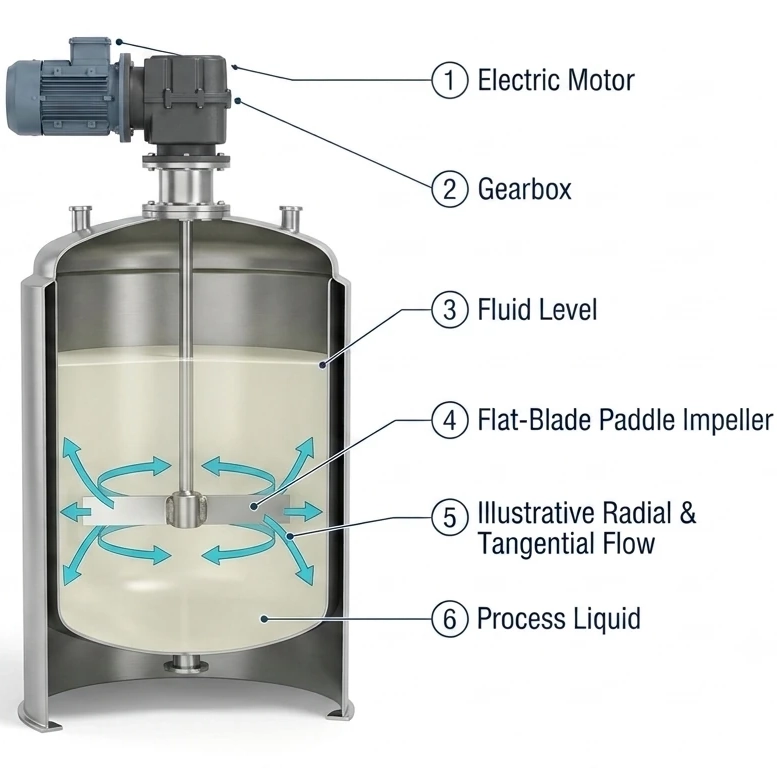
Conventional flat-blade paddle impellers primarily generate radial and tangential fluid movement. Modified designs, including angled or pitched paddles, can introduce additional axial circulation depending on blade geometry and vessel arrangement.
Paddle impellers are commonly considered for liquid blending and relatively gentle agitation where high-intensity dispersion is not the primary requirement. Their suitability depends on fluid viscosity, vessel dimensions, mixing objectives and operating conditions.
Paddle Impeller at a Glance
Blade Construction
Broad, flat blades mounted on a rotating shaft or central hub.
Mixing Characteristics
Primarily radial and tangential circulation for conventional flat-blade designs.
Typical Purpose
Liquid blending and controlled agitation in industrial tanks and process vessels.
How Does a Paddle Impeller Work?
A paddle impeller works by rotating broad blades through the liquid inside a tank or process vessel. As the blades move, they transfer motion to the surrounding fluid, generating circulation that helps distribute liquid throughout the mixing zone.
In a conventional flat-blade paddle impeller, fluid movement is primarily radial and tangential. The blades push liquid outward from the rotating shaft while also creating circumferential movement around the vessel. The resulting circulation depends on the blade configuration, fluid properties and tank arrangement.
In an unbaffled vessel, excessive rotational movement can cause the liquid to swirl with limited vertical mixing. Where appropriate, tank baffles or an alternative impeller arrangement may be considered to improve bulk circulation. Angled or pitched paddle configurations can also introduce an axial-flow component.
What Influences the Mixing Pattern?
Blade Configuration
Flat, angled and multi-stage paddle arrangements produce different flow characteristics depending on their geometry and installation.
Vessel Arrangement
Tank dimensions, impeller position and baffle configuration influence how liquid circulates within the vessel.
Process Conditions
Fluid viscosity, operating speed and liquid level affect circulation behavior and the suitability of the selected impeller.
Types of Paddle Impellers and Blade Configurations
Paddle impellers are available in different blade arrangements to accommodate varying industrial mixing requirements. Blade geometry, orientation and the number of mixing stages influence fluid circulation, mechanical loading and suitability for a particular process.
SV Industries offers application-specific paddle impeller configurations based on vessel dimensions, fluid characteristics, material requirements and mixing objectives.
Flat-Blade Paddle Impeller
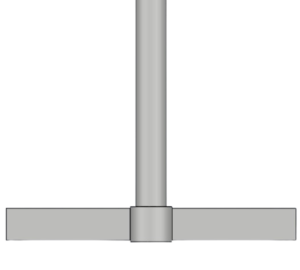
A flat-blade paddle impeller features broad, straight blades mounted on a central hub or rotating shaft. Conventional configurations primarily generate radial and tangential fluid movement.
Liquid blending and general-purpose agitation where strong axial pumping is not the primary requirement.
Angled or Pitched Paddle Impeller
Angled paddle impellers feature blades positioned at an inclination to the plane of rotation. Depending on the blade geometry, these arrangements can introduce an axial-flow component alongside radial and tangential circulation.
Process-specific liquid blending where additional vertical circulation is beneficial.
Perforated Paddle Impeller
A perforated paddle impeller incorporates openings within the blade surface. These openings modify how liquid passes through and around the blade, influencing local fluid movement and mechanical resistance.
Customized mixing duties where a perforated blade arrangement is appropriate for the fluid and process conditions.
Multi-Blade and Multi-Stage Paddle Impellers
Multi-blade paddle impellers incorporate additional blades within a mixing assembly, while multi-stage configurations use paddle sets positioned at different heights along the shaft.
Customized vessels requiring additional mixing zones or circulation across different liquid levels.
The most suitable paddle impeller configuration depends on the process fluid, mixing objective, vessel geometry and operating conditions. Blade arrangement and construction details should be reviewed for each application rather than selected solely by impeller type.
Paddle Impeller Design and Construction
The construction of a paddle impeller influences its mechanical reliability, installation compatibility and suitability for industrial mixing applications. A typical assembly consists of paddle blades connected to a central hub or agitator shaft, with the arrangement selected according to the mixing duty and vessel configuration.
At SV Industries, paddle impeller designs can be customized to accommodate application-specific blade arrangements, shaft connections and fabrication requirements.
Paddle Blade Design
Paddle blades are generally fabricated from flat metal sections, with their shape, orientation and arrangement selected for the intended mixing duty. Blade construction must account for mechanical loading, process-fluid characteristics and compatibility with the vessel.
Hub and Shaft Connection
The central hub or shaft connection supports the paddle blades and transmits rotational motion from the agitator drive. Depending on the application, fixed welded connections or suitable removable mounting arrangements may be considered.
Fabrication and Joint Quality
Proper fabrication is important for maintaining blade alignment, structural integrity and assembly fit. Welded joints, blade positioning and dimensional accuracy should be appropriate for the intended operating conditions and maintenance requirements.
Surface Finish and Maintenance
Surface finishing requirements depend on the process fluid, cleaning method and operating environment. Smooth, accessible surfaces and appropriate joint detailing can support cleaning and inspection where required.
Application-Specific Construction:
The final paddle impeller arrangement should be reviewed together with the agitator shaft, vessel geometry and operating requirements to ensure the assembly is suitable for its intended industrial mixing application.
Materials Used in Paddle Impeller Manufacturing
Material selection plays an important role in the durability, corrosion resistance and service suitability of an industrial paddle impeller. The appropriate material depends on the process fluid, chemical concentration, operating temperature, cleaning requirements and expected service conditions.
SV Industries offers paddle impellers in stainless steel, mild steel and application-specific corrosion-resistant alloys. Material specifications can be selected according to project requirements and confirmed process compatibility.
Stainless Steel 304 (SS304) Paddle Impeller
SS304 paddle impellers are commonly considered for general industrial liquid mixing, food processing and other applications where the process environment is compatible with this stainless steel grade.
SS304 offers good general corrosion resistance, fabrication flexibility and cleanable surfaces when appropriately finished.
Suitability should be verified where chlorides, aggressive chemicals or elevated temperatures are present.
Stainless Steel 316 (SS316) Paddle Impeller
SS316 paddle impellers contain molybdenum, providing improved resistance to certain forms of localized corrosion compared with SS304.
They may be considered for chemical processing, pharmaceutical manufacturing and other applications requiring increased corrosion resistance.
SS316 is not universally resistant to acids, chlorides or aggressive process chemicals. Fluid composition and operating conditions must be evaluated.
Mild Steel (MS) Paddle Impeller
Mild Steel paddle impellers provide a practical fabrication option for suitable non-corrosive industrial mixing applications.
MS construction may be considered for general-purpose agitation where material compatibility, mechanical requirements and maintenance conditions permit its use.
Corrosion protection, including an appropriate coating or lining where required, should be evaluated according to the process environment.
Hastelloy Paddle Impeller
Hastelloy nickel-alloy paddle impellers may be considered for specialized chemical processing applications where conventional stainless steel grades do not provide sufficient corrosion resistance.
Different Hastelloy alloy grades offer different chemical compatibility characteristics. The appropriate alloy should be selected for the specific process medium and operating conditions.
The exact alloy grade, chemical concentration, operating temperature and fabrication requirements must be confirmed before finalizing the material.
How to Select the Right Paddle Impeller Material
The final material selection should consider chemical compatibility, process temperature, corrosion exposure, fabrication requirements, surface finish and expected service life.
For chemical-processing applications, share the fluid composition, concentration, operating temperature and cleaning requirements with SV Industries so that a suitable material of construction can be reviewed.
Paddle Impeller Technical Specifications and Customization
Paddle impeller specifications are determined by the required mixing duty, process-fluid characteristics and vessel configuration. Important parameters include impeller diameter, blade geometry, material of construction, shaft connection and the number of mixing stages.
SV Industries provides application-specific paddle impeller customization for industrial tanks, reactors and agitator assemblies. Rather than applying one fixed specification to every installation, the appropriate configuration is reviewed according to the customer’s technical requirements.
Paddle Impeller Specification Overview
| Technical Parameter | Specification Basis |
|---|---|
| Impeller Type | Flat-blade, angled, perforated or multi-stage configurations, subject to application review. |
| Impeller Diameter | Selected according to vessel dimensions, mixing duty and installation clearances. |
| Blade Design | Blade shape, width, inclination and quantity according to project requirements. |
| Number of Stages | Single or multiple paddle stages depending on liquid level and vessel arrangement. |
| Hub and Shaft Connection | Connection arrangement selected for compatibility with the agitator shaft and assembly. |
| Material of Construction | SS304, SS316, Mild Steel or application-specific alloy, subject to material compatibility. |
| Surface Finish | Selected according to process requirements, cleaning needs and construction material. |
| Operating Speed | Reviewed together with agitator drive selection and fluid mixing requirements. |
| Vessel Compatibility | Reviewed for tank geometry, operating liquid level, impeller location and clearances. |
Paddle Impeller Customization Options
Custom blade geometry, orientation, quantity and paddle arrangement can be reviewed for the required mixing application.
Impeller diameter, blade proportions and installation dimensions can be specified according to vessel geometry and operating requirements.
Hub connections, shaft interfaces and suitable mounting arrangements can be reviewed for new or existing agitator assemblies.
Material grade and finishing requirements can be specified based on process compatibility, corrosion exposure and maintenance requirements.
Information Required for Paddle Impeller Selection
For an application-specific paddle impeller enquiry, provide the vessel dimensions, working liquid level, process fluid, approximate viscosity, mixing objective and preferred material of construction.
Where the impeller is intended for an existing agitator, relevant shaft dimensions, operating speed and available assembly drawings are also useful.
Paddle Impeller Mixing Patterns and Tank Compatibility
The mixing behavior of a paddle impeller depends on both the blade configuration and the vessel in which it operates. Tank dimensions, shaft position, baffles, liquid level and internal components influence how effectively fluid circulates throughout the mixing volume.
Conventional flat-blade paddle impellers primarily generate radial and tangential flow. Depending on the tank arrangement, this movement may result in substantial circumferential circulation without strong top-to-bottom liquid turnover. For applications requiring extensive vertical circulation or solids suspension, additional design considerations may be necessary.
How Tank Arrangement Affects Circulation
In an unbaffled vessel, rotational fluid movement may dominate, particularly with centrally mounted impellers. Excessive swirling can reduce effective bulk mixing and may produce a surface vortex under certain operating conditions.
Baffles can reduce tangential swirling and modify liquid circulation within the vessel. Their suitability depends on the fluid properties, impeller arrangement and mixing objective. Baffles are not necessary for every application.
In tall vessels or processes with changing liquid levels, a single paddle impeller may not provide the required circulation throughout the working volume. Multi-stage paddles or alternative mixing arrangements may be considered.
Vessel Fit and Installation Checks
The selected paddle assembly must fit within the vessel while maintaining suitable clearance from the tank wall, bottom and internal components.
The shaft location and impeller installation height influence circulation behavior and should be reviewed for the intended mixing duty.
The working and minimum liquid levels should be considered to confirm suitable impeller submergence during operation.
Flat, dished and other vessel-bottom configurations can affect impeller placement and available installation clearance.
Baffles, heating coils, dip pipes, nozzles and other internal fittings should be considered when reviewing impeller installation and mechanical compatibility.
Selecting a Suitable Mixing Arrangement
The final paddle impeller arrangement should be selected according to the required liquid movement, process conditions and vessel configuration. Where strong axial circulation, demanding solids suspension or close-clearance wall mixing is required, another impeller configuration may be more appropriate.
Industrial Applications of Paddle Impellers
Paddle impellers are used in industrial mixing applications where liquid blending, controlled agitation and application-specific circulation are required. Their suitability depends on fluid properties, mixing objectives, vessel arrangement and operating conditions.
SV Industries provides customized paddle impeller configurations for chemical processing, pharmaceutical manufacturing, food and beverage production, water treatment, cosmetics and related process industries. Each application is reviewed according to its specific mixing requirements rather than applying one impeller design to every process.
Chemical & Specialty Chemical Processing
Paddle impellers may be considered for blending compatible process liquids, mixing liquid additives and maintaining circulation during suitable batch preparation operations.
Chemical formulations, coatings, resins and slurries can have different rheological characteristics. The mixing arrangement must therefore be reviewed for the specific process.
Chemical compatibility, viscosity, solids characteristics and required mixing duty.
Pharmaceutical & Fine Chemical Processing
Paddle impeller arrangements may be suitable for controlled liquid blending in pharmaceutical and fine chemical process vessels where the required mixing intensity and fluid properties are compatible with paddle agitation.
Material selection, surface finish, cleanability and applicable process quality requirements should be considered before finalizing the equipment configuration.
Product compatibility, cleaning requirements, process conditions and required circulation.
Food & Beverage Processing
Paddle impellers can be considered for suitable liquid ingredient blending, syrup preparation and controlled agitation of compatible food and beverage formulations.
The selected configuration should account for product viscosity, temperature, cleaning practices and applicable food-contact material requirements.
Product characteristics, hygienic construction, surface finish and cleaning requirements.
Water & Wastewater Treatment
Paddle-based agitation is used in selected water-treatment operations, including chemical solution preparation and appropriately designed gentle mixing processes.
Purpose-designed paddle flocculators are also used for controlled agitation during floc formation. Their mechanical arrangement and operating requirements can differ from those of a conventional tank-mounted paddle impeller.
Required mixing intensity, process chemistry, shear sensitivity and tank or basin arrangement.
Cosmetics & Personal Care
Paddle impellers may be considered for blending compatible liquid cosmetic formulations, cleansing products and suitable lotion premixes where controlled agitation is required.
High-viscosity creams, demanding emulsification processes or materials requiring close-clearance wall mixing may need a different impeller or additional mixing equipment.
Fluid rheology, mixing objective, material compatibility and cleaning requirements.
The appropriate paddle impeller configuration depends on the actual mixing duty rather than the industry category alone. Fluid properties, working volume, vessel geometry and required circulation should be reviewed together.
For complete drive, shaft and mixing-system requirements, see our industrial agitator systems .
Paddle Impeller vs Other Mixing Impellers
Selecting the right industrial mixing impeller depends on the required fluid circulation, mixing intensity, product characteristics and vessel configuration. Paddle, anchor, turbine and propeller impellers have different blade geometries and mixing characteristics, making each suitable for particular processing requirements.
A conventional paddle impeller is often considered for controlled liquid blending and relatively straightforward agitation duties. Other impeller types may be more appropriate when strong axial circulation, near-wall movement, gas dispersion or specialized mixing performance is required.
Industrial Mixing Impeller Comparison
| Impeller Type | Typical Flow Pattern | Mixing Applications | Selection Considerations |
|---|---|---|---|
| Paddle Impeller | Primarily radial and tangential for conventional flat-blade paddles. | Controlled liquid blending, general-purpose agitation and suitable low-intensity mixing duties. | Limited vertical turnover may require modified geometry, baffles or another impeller arrangement. |
| Anchor Impeller | Primarily tangential and near-wall material movement. | Viscous bulk mixing and selected temperature-controlled processing applications. | Close-clearance geometry; scrapers may be added where required and suitably designed. |
| Pitched Blade Turbine | Combined axial and radial circulation, depending on blade and installation arrangement. | Bulk liquid circulation, liquid blending and suitable solids-suspension duties. | Pumping direction, shear, vessel geometry and drive requirements need review. |
| Rushton Turbine | Predominantly radial discharge with relatively high local mixing intensity. | Gas-liquid dispersion and process duties requiring strong local turbulence. | Power demand, gas handling, shear sensitivity and process conditions. |
| Propeller Impeller | Predominantly axial circulation for conventional marine-style propeller configurations. | Bulk liquid movement and suitable blending duties, commonly in lower-viscosity fluids. | Propeller geometry, operating conditions and tank configuration determine suitability. |
Note: These are general characteristics of conventional impeller types. Actual mixing performance depends on fluid properties, blade geometry, vessel configuration and operating conditions.
How to Choose the Right Mixing Impeller
A paddle impeller may be suitable when the process requires controlled liquid blending or relatively straightforward agitation without strong axial pumping as the primary requirement.
Strong vertical circulation, demanding gas dispersion, near-wall viscous mixing or specialized solids suspension may require a different impeller configuration.
Compare the mixing objective, fluid viscosity and rheology, vessel dimensions, liquid level, material compatibility and available agitator arrangement.
For close-clearance mixing of viscous materials, review our Anchor Impeller . For mixing duties requiring additional axial circulation, see our Pitched Blade Turbine .
For selected gas-dispersion applications, review our Rushton Turbine . Complete motor, gearbox, shaft and mixing-system configurations are covered under Industrial Agitators .
Paddle Impeller Advantages and Selection Considerations
Paddle impellers offer a straightforward and adaptable approach to industrial liquid agitation. Their relatively simple blade construction, customizable arrangements and compatibility with suitable tank-mounted agitator systems make them a practical option for selected blending and mixing duties.
However, the advantages of a paddle impeller depend on the process application. Mixing effectiveness, mechanical loading and operating requirements should be evaluated alongside fluid properties, vessel geometry and the desired circulation pattern. Understanding both the benefits and limitations helps buyers select a configuration suited to their process.
Practical Advantages of Paddle Impellers
Conventional paddle impellers use relatively straightforward blade and hub arrangements. This construction can simplify fabrication, dimensional inspection and access to individual components, depending on the assembly design.
Blade dimensions, orientation, number of paddles and mounting arrangements can be reviewed according to vessel geometry, fluid characteristics and process requirements.
Paddle arrangements may be suitable for relatively gentle liquid agitation where high-intensity dispersion is not the main objective. Actual shear and circulation depend on operating conditions.
Suitable paddle assemblies can be designed for integration with industrial agitator shafts, drives and mixing vessels. Connection dimensions and mechanical loading must be reviewed before installation.
Key Selection Considerations
Define whether the application requires liquid blending, bulk circulation, solids suspension or another specific mixing objective.
Review viscosity, rheology, density, solids characteristics and process-fluid compatibility.
Consider vessel dimensions, working and minimum liquid levels, impeller position, baffles and internal clearances.
Confirm shaft connection, drive suitability, operating conditions and anticipated mechanical loading.
Assess material compatibility, joint accessibility, surface finish, cleaning requirements and replacement considerations.
When to Consider an Alternative Mixing Arrangement
Conventional flat-blade paddle impellers may not provide sufficient vertical circulation for every vessel or process. Applications requiring strong axial pumping, demanding solids suspension, intensive dispersion or close-clearance wall mixing may benefit from another impeller configuration.
The final selection should balance the required mixing outcome, mechanical suitability and practical operating requirements rather than relying on a single claimed advantage.
Why Choose SV Industries for Paddle Impellers?
SV Industries is an industrial agitator and process equipment manufacturer based in Ahmedabad, Gujarat, India. We manufacture and supply paddle impellers for industrial mixing applications, with configurations developed around the required mixing duty, process-fluid characteristics and vessel arrangement.
Our manufacturing scope includes customized paddle impeller assemblies and industrial agitator systems. Customers can discuss blade configuration, material selection, shaft compatibility and installation requirements for new equipment or existing mixing vessels.
Manufacturing and Customization Capabilities
SV Industries manufactures industrial agitators, mixing components and process equipment from Ahmedabad, Gujarat, serving industrial equipment requirements across India.
Paddle blade geometry, arrangement, impeller dimensions and mounting requirements can be discussed according to the intended mixing duty and vessel configuration.
Stainless Steel 304, Stainless Steel 316, Mild Steel and specified corrosion-resistant alloys can be considered according to process compatibility and confirmed project requirements.
Paddle impeller requirements can be reviewed alongside agitator shafts, drive assemblies and process vessels, including new installations and suitable existing equipment.
From a replacement paddle assembly to an impeller for a new mixing system, SV Industries can review application-specific requirements and discuss suitable construction and supply options. Final specifications depend on the confirmed project scope.
Frequently Asked Questions About Paddle Impellers
What is a paddle impeller used for?
A paddle impeller is used for liquid blending, controlled agitation and suitable industrial mixing duties. Conventional flat-blade paddles primarily produce radial and tangential fluid movement. The appropriate configuration depends on the process fluid, vessel geometry and required mixing outcome.
How does a paddle impeller differ from other types of impellers?
Conventional paddle impellers use broad blades for primarily radial and tangential circulation. Pitched Blade Turbines can provide stronger axial circulation, while anchor impellers are often selected for suitable viscous and near-wall mixing duties. Each configuration should be evaluated for the specific application.
What industries use paddle impellers?
Paddle impellers are considered in chemical processing, pharmaceutical and fine chemical manufacturing, food and beverage production, water treatment and cosmetics. Their suitability depends on the actual mixing duty, fluid properties, construction material and process requirements.
Can paddle impellers handle high-viscosity fluids?
Some paddle configurations can be designed for moderately viscous or application-specific higher-viscosity fluids. However, conventional paddles are not universally suitable for highly viscous products. Fluid rheology, required circulation, vessel geometry and available drive torque should be reviewed. An anchor or another specialized impeller may be more appropriate.
Can a paddle impeller be customized for an existing agitator?
Yes. A replacement or customized paddle assembly can be reviewed for compatibility with an existing agitator. Useful information includes the shaft diameter, connection details, vessel dimensions, operating speed, process fluid and any available drawings. Final suitability depends on mechanical and process requirements.
Are paddle impellers energy efficient?
Energy consumption depends on impeller geometry, rotational speed, fluid properties, vessel arrangement and the required mixing duty. A paddle impeller may be an appropriate choice for selected controlled-agitation applications, but lower speed alone does not guarantee lower total power consumption or improved efficiency.
How long do paddle impellers last?
Service life varies with material selection, corrosion exposure, mechanical loading, operating conditions and maintenance practices. There is no universal service-life guarantee for every paddle impeller. Appropriate construction, operating practices and periodic inspection can support reliable service.
What maintenance is required for paddle impellers?
Maintenance typically includes inspection of blades, welds, hub or shaft connections, corrosion, deformation and material buildup. Cleaning and inspection intervals should reflect the process fluid, duty cycle and equipment operating conditions. The complete agitator drive and shaft assembly should also be maintained as applicable.
How do I order a paddle impeller from SV Industries?
Share your mixing application, process fluid, vessel dimensions, working liquid level, preferred material and required paddle configuration through the SV Industries enquiry page. For replacement assemblies, existing shaft details and drawings are useful. The final configuration and supply scope can then be discussed.
Related Agitator & Impeller Solutions
A paddle impeller is one component of an industrial mixing system. Depending on the process requirements, the application may also involve a complete agitator assembly, a compatible reactor vessel or an alternative impeller design for different circulation and mixing duties.
01
Industrial Agitator
Agitator systems configured for blending, suspension, heat transfer and other process mixing duties.
02
Reactor Vessel
Custom reactor vessel design and fabrication for project-specific mechanical and process requirements.
03
Anchor Impeller
Close-clearance mixing impellers considered for suitable viscous products and near-wall material movement. Scraper arrangements can be evaluated where required.
04
Pitched Blade Turbine
Industrial mixing impellers providing axial and radial circulation for liquid blending, bulk movement and suitable solids-suspension applications.
Request a Custom Paddle Impeller Quote
Looking for a custom paddle impeller for a new agitator, mixing tank, reactor vessel or existing mixing system? Share your application and vessel requirements with SV Industries to discuss a suitable paddle impeller configuration.
Provide details such as mixing duty, process fluid, viscosity, vessel dimensions, working volume, liquid level, operating temperature, material of construction and existing agitator or shaft details. These inputs help us review the appropriate paddle blade arrangement, impeller diameter, shaft connection, number of stages and agitator compatibility for your application.